
The History of the Heart Symbol: How ♥ Became the Sign of Love
By The Cool Symbol Team on 2026-05-29
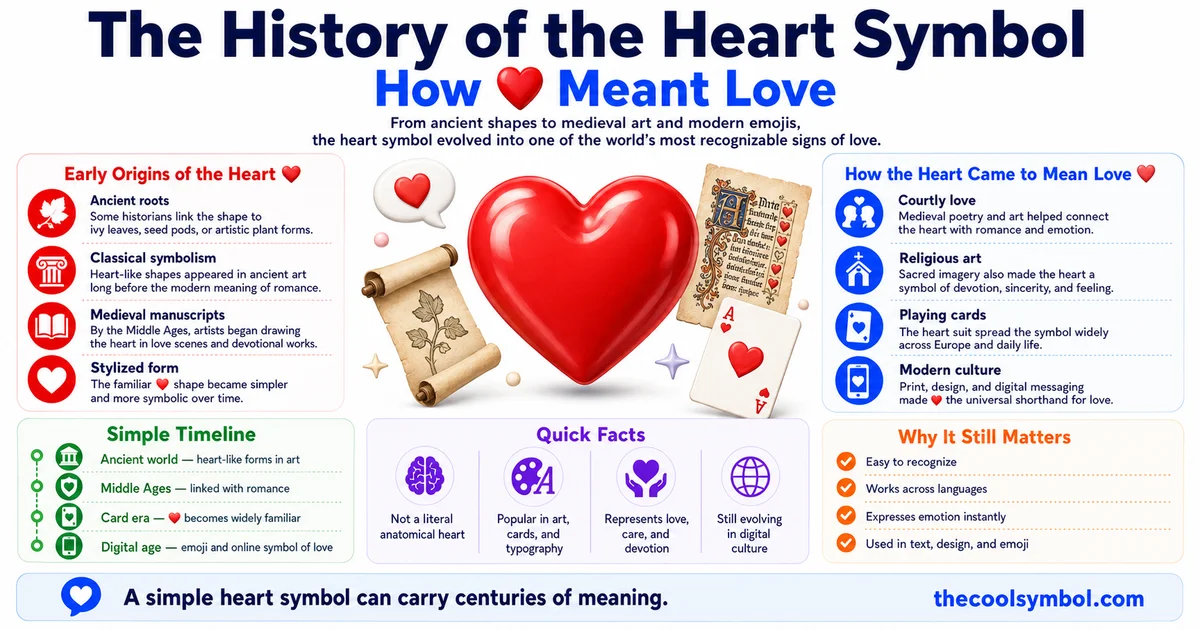
Look at the heart symbol you tap a hundred times a day. The one on every like button, every emoji keyboard, every Valentine’s card.
Now picture an actual human heart. Lopsided. Reddish-brown. Shaped like a clenched fist with tubes coming out the top. The two look nothing alike.
So where did the symbol come from? Why does the thing we use for love look nothing like the organ it’s named after? The answer runs back more than 2,500 years, through an extinct plant, ancient Greek medicine, medieval poetry and a French playing-card factory.
This is the strange, winding story of how a simple two-lobed shape became the most recognized symbol of love on Earth.
Theory 1: the extinct plant that may have started it all
The most surprising origin story begins with a plant that no longer exists.
Around 2,500 years ago, a Greek colony called Cyrene (on the coast of modern Libya) grew rich on a plant called silphium. It was a species of giant fennel and the ancient world treated it as a wonder herb. People used it to flavor food, soothe coughs and most famously, as an early form of birth control.
Silphium was so valuable to Cyrene’s economy that the city stamped it on their coins. And here’s the detail that matters: the silphium seedpod was shaped almost exactly like the heart symbol we use today. Two rounded lobes at the top, tapering to a point at the bottom.
Coins minted in Cyrene between roughly 650 and 300 BCE, many now held in the British Museum, show that seedpod in a shape that looks unmistakably like a modern heart.
Because silphium was tied to love, sex and fertility (thanks to its use as contraception), some historians believe the connection between the shape and romantic love started right there. The scholar Pierre Vinken made this argument in detail in his 2001 study “The Shape of the Heart.”
The plant was eventually harvested into extinction. But the visual link between its seedpod and love may have outlived the plant itself by 2,000 years.
Theory 2: leaves that look like love
Silphium isn’t the only plant in the running. Several leaves share the heart’s distinctive shape and several cultures noticed.
Ivy leaves
Ivy leaves have a heart-like silhouette and the ancient Greeks associated ivy with fidelity and with Dionysus, the god of wine and passion. That gives ivy a believable connection to love and desire. Some historians think its shape reinforced the symbol.
Peepal leaves
Long before Cyrene, the Indus Valley civilization in ancient India used heart-shaped peepal tree leaves in their art. A heart-shaped pendant from that civilization is now displayed in the National Museum of India. The shape clearly appealed to humans across many separate cultures.
Fig and water lily leaves
The fig leaf was tied to sensuality in ancient art and the rounded water lily leaf may have quietly reinforced the heart motif in decoration over the centuries. The shape kept showing up because nature kept offering it.
Theory 3: medieval doctors drawing from memory
The most academically respected theory is also the least romantic. The heart shape may simply be a bad drawing of a real heart.
For most of human history, nobody knew what a heart actually looked like inside a living body. Dissection was rare or forbidden. So physicians relied on ancient written descriptions instead of looking for themselves.
The Greek physician Galen, writing in the 2nd century, described the heart as having three chambers with a small dent in the middle. The philosopher Aristotle described something similar. The Persian scholar Avicenna, writing in the 11th century, described the heart as resembling a pine cone: broad at the top, narrowing to a point at the bottom.
Medieval artists who had never seen a real heart tried to draw these written descriptions. In the 14th century, the Italian physician Guido da Vigevano made a series of anatomical drawings featuring a heart that closely matches Aristotle’s description. The result was a stylized, symmetrical shape that looked more like our modern symbol than like a real organ.
Since the heart was already believed to be the seat of emotion and the center of the soul, this stylized shape became the natural pictogram for love. A drawing error, repeated for centuries, became the universal symbol of the heart.
The heart symbol timeline at a glance
From an extinct plant to the like button on your phone, here’s how the shape traveled through history.
Notice the gap. The shape existed for over a thousand years before it firmly meant love. The symbol and the meaning arrived separately, then merged in medieval Europe.
When the heart actually became the symbol of love
Here’s the part most people get wrong. The heart shape did not mean romantic love for most of its history. That connection is surprisingly recent.
The shape existed on coins, leaves and anatomical drawings for centuries without any romantic meaning attached. The link to love didn’t lock in until somewhere between the 13th and 15th centuries, in medieval Europe.
The turning point was courtly love. In 13th and 14th century France, traveling poets called troubadours sang about chivalry and devotion. A troubadour would pledge his whole heart to one woman. This idea of romantic love centered on the heart spread through their poetry and song across Europe.
Around 1250, the French writer Thibaut created a miniature showing a man offering his heart to a woman, considered by some the first heart depiction in art (though it looked more like a pear or pine cone than our modern shape). By 1338-44, an artwork called “The Heart Offering” showed the heart clearly as a symbol of romantic love.
From there the shape only got more refined. By the 15th century, the red heart became a standard suit symbol on European playing cards, which put the shape into the hands of ordinary people across the continent. The symbol was now everywhere and it meant love.
Want to use the heart symbol or copy any of its variations? Browse the full heart symbols and emoji collection here →. Every heart style, from the classic ♥ to every colored emoji, ready to copy and paste anywhere.
From medieval art to your emoji keyboard
The heart’s journey didn’t stop in the Middle Ages. The last 150 years pushed it further into daily life than any troubadour could have imagined.
In the Victorian era, the heart became central to Valentine’s Day cards, which industrialized romantic gift-giving. Mass-produced cards put the red heart in millions of hands every February.
Then came “I ♥ NY” in 1977, the Milton Glaser logo that turned the heart into a verb. For the first time, the heart shape stood in for the word “love” in everyday text. That tiny design choice reshaped how we use the symbol.
The digital era finished the job. Emoji keyboards gave the heart a dozen colors, each with its own meaning. The social media “like” button (especially after Instagram and Twitter adopted the heart) turned it into the most tapped symbol in human history. Billions of heart taps happen every single day.
And here’s where the ancient shape gained modern nuance. Each color now carries its own meaning, something no medieval artist could have predicted.
The heart symbol’s modern color meanings
The single medieval heart has split into a whole spectrum of meanings. The color you pick now changes the message completely.
The red heart still carries the classic, direct meaning of love that medieval Europe gave it. It’s the closest descendant of the original romantic symbol.
The black heart took on a modern, ironic and sometimes mournful meaning that only emerged in the digital age. There’s nothing medieval about it.
The purple heart picked up cultural weight from BTS fandom and the US military Purple Heart medal, meanings tied to specific modern communities.
And the white heart became the quiet symbol of purity, peace and minimalist aesthetics, a soft modern cousin of the loud red original.
The same shape that started on a Greek coin now carries dozens of distinct meanings depending on its color. The history kept layering instead of replacing.
Why the heart shape is universal but its meaning isn’t
One of the strangest things about the heart symbol is how universal the shape became while the meanings stayed local.
Nearly every culture on Earth now recognizes the heart shape. But the emotions attached to it still vary. In most Western cultures, the heart means romantic love. In parts of East Asia, the heart gesture (made with fingers) became a casual sign of affection popularized by K-pop. In some religious traditions, the heart represents divine or spiritual love rather than romance.
The shape traveled the world through trade, art, playing cards and finally the internet. But each culture poured its own meaning into the same outline. The heart became a universal container that holds whatever a culture means by love.
Wrapping up
The heart symbol is one of the great accidents of human history. It might come from an extinct contraceptive plant, or from leaves, or from medieval doctors drawing organs they had never seen. Most likely it’s a blend of all three, refined over 2,500 years into the shape you tap every day.
What’s certain is that the shape came first and the meaning came later. For over a thousand years it was just a pleasing outline. Only in medieval Europe, through poetry and playing cards, did it become the sign of love. And only in the digital age did it split into the rainbow of meanings we use now.
Next time you tap a heart, you’re using a symbol older than most countries, shaped by plants, poets and a few anatomical mistakes along the way.