
Purple Heart 💜 Meaning: From BTS Fandom to Military Honor
By The Cool Symbol Team on 2026-05-26
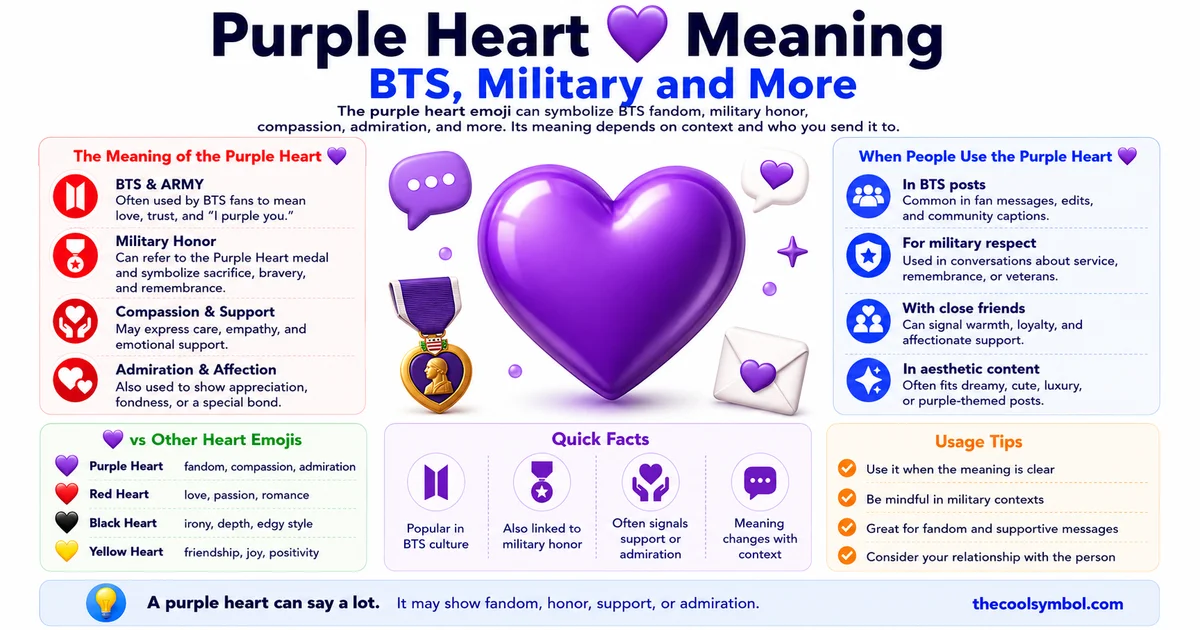
The purple heart emoji has two very different homes on the internet.
In one corner: BTS ARMY using the purple heart thousands of times a day to express love for a Korean boy band. In the other corner: US military families using the same emoji to honor wounded veterans on Memorial Day.
Same symbol. Two completely separate worlds. Most people who use the purple heart never think about the other group and most online searches for “purple heart meaning” lead readers into one universe or the other without realizing both exist.
This guide covers both. You’ll learn what the purple heart means in K-pop fandom, what the Purple Heart medal represents in military culture, the older meanings of the color purple that gave the emoji weight and the modern situations where sending it lands right or wrong.
The short answer: what the purple heart actually means
The purple heart carries four main meanings depending on context.
- BTS ARMY love and K-pop fandom (the dominant online use)
- Military honor and remembrance (especially in US contexts)
- Compassion, understanding and emotional support
- Royalty, luxury and creative expression
Unlike the red heart which mostly means romantic love, the purple heart shifts dramatically based on who’s sending it. The same emoji from a K-pop fan account means something completely different from one on a veteran’s Memorial Day post.
The good news: both meanings are widely understood now. The context around the emoji usually tells you which one is in play.
Meaning 1: BTS ARMY and the K-pop takeover
The biggest single reason the purple heart exploded in usage over the last decade has a specific origin story. And it traces back to one moment.
“I purple you”
At a fan meeting in November 2016, BTS member V (Kim Taehyung) coined the phrase “I purple you” (보라해 / borahae in Korean). He told fans that because purple is the last color of the rainbow, it means “I will trust and love you for a long time.”
Within weeks, ARMY (the BTS fandom) had adopted purple as the official color of their love for the band. Within a year, the purple heart became the unofficial emoji of K-pop fandom globally. By 2020, it was inseparable from BTS-related posts on every social platform.
If you’ve ever wondered why Twitter explodes with purple hearts every time BTS posts something, this is why. Hundreds of millions of fans treat the emoji as the visual shorthand for the band’s name.
Beyond BTS
The K-pop spread didn’t stop with BTS. Other groups (NCT, SEVENTEEN, BLACKPINK fans) also use the purple heart to mark fandom posts, even when their group’s official color is different. The purple heart became the universal K-pop affection emoji because BTS made it that way.
If you’re not in K-pop and you see a Twitter bio with a purple heart next to a Korean name, you’re looking at a fan account. Almost always.
Meaning 2: the Purple Heart military medal
Long before any emoji existed, the Purple Heart was the oldest active military decoration in the United States.
Where it started
George Washington created the original Badge of Military Merit in 1782. It was a purple cloth heart awarded to soldiers wounded in combat during the Revolutionary War. Only three soldiers received it before the award fell out of use.
In 1932, on the 200th anniversary of Washington’s birth, the US Army revived the award as the Purple Heart medal. Today, it’s awarded to American service members wounded or killed in combat. Approximately 1.8 million Purple Hearts have been issued since World War I.
Because of this history, the purple heart carries serious weight in military contexts. Veterans, military families and people thanking servicemembers use the emoji on Memorial Day, Veterans Day and around the August 7 Purple Heart Day.
How to recognize military usage
Military uses of the purple heart almost always pair the emoji with:
- References to veterans, soldiers, or fallen servicemembers
- Specific dates like Memorial Day, Veterans Day, or Purple Heart Day (August 7)
- Flag emojis, especially 🇺🇸
- Hashtags like #PurpleHeart, #WoundedWarrior, or #ThankAVet
If you see the purple heart in any of these contexts, the meaning is honor and remembrance, not fandom love.
Visual: decoding the purple heart by who’s sending it
Same emoji, three very different meanings depending on the surrounding signals.
The signals around the emoji are the meaning. A purple heart on a BTS post means one thing. The same heart on a veteran’s Memorial Day photo means something completely different. Read context before the symbol.
The older meanings of purple that shaped the emoji
Long before BTS or any military medal, the color purple already carried specific meanings across human history. Those older associations are why the emoji feels different from the red, blue, or yellow heart even when you can’t articulate why.
Royalty and luxury
In ancient Rome, purple dye was made from a rare sea snail and cost roughly the equivalent of $1,000 per gram in today’s money. Only emperors, senators and the wealthiest citizens could afford to wear it. The phrase “born to the purple” still means born into royalty.
That historical association makes purple feel expensive and important even now. A purple heart implicitly carries more weight than a plain heart in many people’s reading.
Spirituality and intuition
Purple is the color associated with the crown chakra in Hindu and Buddhist traditions, with intuition in Western mysticism and with mourning during Lent in Christian liturgy. Across multiple religions, purple signals depth, reflection and the sacred.
Mental health and awareness
Purple is the color of several awareness ribbons: lupus, Alzheimer’s, domestic violence awareness, fibromyalgia and others. People who post the purple heart alongside mental health content are often signaling solidarity with one of these communities, even when the specific cause isn’t named.
How people actually use the purple heart today
Beyond the two big meanings, the purple heart has settled into a few specific everyday uses.
Compassion and emotional support
When a friend posts about a hard week, anxiety, grief, or burnout, sending a purple heart reads as “I understand, I’m here.” It’s softer than the red heart (which can read as romantic) and warmer than the black heart (which can read as cold). The purple sits between them.
Pride and LGBTQ+ contexts
Purple is part of the rainbow flag and the bisexual flag specifically uses purple as its center color (representing attraction to multiple genders). The purple heart shows up in Pride content as a quieter expression of identity or support.
Creative and artistic expression
Designers, artists, musicians and writers use the purple heart to mark creative posts. The color has a creative-class association (think Prince’s iconic purple aesthetic, the Pantone Color of the Year 2018 “Ultra Violet”) that makes it a marker for creative identity.
Friendship between women
Many female friend groups have adopted the purple heart as their “this is a friend, not a partner” alternative to the red heart. It’s affectionate without being romantic, expressive without being too soft.
Need to copy the purple heart or any other heart color? Browse the full heart symbols and emoji collection here →. Every heart, ready to copy and paste anywhere you type.
When to send the purple heart
Good times to send it
- Supporting a friend going through something hard
- Celebrating a creative win (someone’s art, music, writing)
- K-pop fandom interactions where the purple heart is the cultural language
- Memorial Day, Veterans Day, or Purple Heart Day posts honoring service members
- Female friendships where you want warmth without romantic connotation
- Mental health awareness content
Times to skip it
- New romantic interests (use red, pink, or sparkling heart for clarity)
- Professional/work contexts where any heart feels out of place
- Posts where the topic is celebration of something purely happy (use 🎉, ❤️, ✨)
- Conversations with people who only know one meaning (K-pop fans might read a non-fandom purple heart as fandom-related)
Purple heart vs other heart colors
The purple sits in an interesting middle ground compared to its more famous siblings.
The red heart is the default love symbol. Direct, romantic, classic. It’s what you send when you mean love in the simplest sense.
The black heart is moody, aesthetic, sometimes grief, often ironic. It’s the cool, detached cousin of the red one.
The purple heart fits between them: warmer than black, less romantic than red, with cultural weight that neither of the others carries (BTS, military, royalty, spirituality). It’s the heart you reach for when red is too obvious and black is too cold.
4 mistakes people make with the purple heart
1. Using it in a new romantic context
A purple heart on day 3 of dating someone is ambiguous. They might read it as romantic interest, as a sign you’re friend-zoning them, as K-pop reference, or as nothing at all. Pick a clearer signal: red for romantic interest, pink for playful affection, sparkling for excited.
2. Posting it on a veteran’s tribute without understanding
If you’re posting the purple heart on a Memorial Day or Veterans Day post and you only know the K-pop meaning, you might miss why people are reacting differently than you expect. The military meaning is the dominant reading in those contexts. Use it intentionally, not by accident.
3. Spamming it in K-pop fan accounts you’re not part of
ARMY uses the emoji as a marker of fandom membership. If you drop a purple heart on a BTS post without being a fan, it can read as performative or like you’re claiming membership you don’t have. Use it when the context is genuine.
4. Reading every purple heart as BTS
Not every purple heart you see online is K-pop related. Older users, military families, mental health communities and creative folks all use it for completely different reasons. Don’t assume fandom unless the context says so.
Frequently Asked Questions
What does the purple heart mean from a girl?
Depends entirely on context. From a K-pop fan, it’s almost always BTS-related fandom love. From a close friend, it’s affectionate friendship without romantic weight. From someone on a mental health post, it’s emotional support. Look at her interests, recent posts and the conversation topic before deciding what it means.
Why is the purple heart associated with BTS?
In 2016, BTS member V coined the phrase “I purple you” (borahae) at a fan meeting, saying purple represents long-lasting trust and love. The fandom adopted it immediately and within a few years, the purple heart became the global emoji of K-pop affection, especially for BTS-related content.
Does the purple heart emoji have a romantic meaning?
Not primarily. The purple heart can be affectionate in close relationships, but its main meanings are fandom love (K-pop), military honor, emotional support and friendship. If you want to clearly signal romantic interest, the red heart or pink hearts are stronger choices. Save the purple for warmth that doesn’t need to be romantic.
Is it disrespectful to use the purple heart if I’m not a BTS fan or military family?
No. The purple heart has multiple legitimate meanings beyond fandom and military, including general compassion, friendship and creative expression. Use it when the context makes your meaning clear. Just be aware that in BTS or veteran contexts specifically, your purple heart will be read through those cultural lenses.
What’s Purple Heart Day and when is it?
Purple Heart Day is observed in the United States on August 7 every year. It commemorates the creation of the Purple Heart medal by George Washington in 1782 and honors all American service members who have been wounded or killed in combat. The emoji floods social media on that date with tribute posts.
Wrapping up
The purple heart is one of the most context-loaded emojis you can send. It can mean K-pop fandom, military honor, compassion, royalty, creative identity, or friendship depending entirely on who’s reading it and what surrounds it.
Read the context. Match your usage to the receiver. And remember that the purple heart is the only emoji whose meaning ranges from a Korean pop star to a 240-year-old military medal in the same scroll session.