
Black Heart 🖤 Meaning: Why People Use It and What It Really Says
By The Cool Symbol Team on 2026-05-25
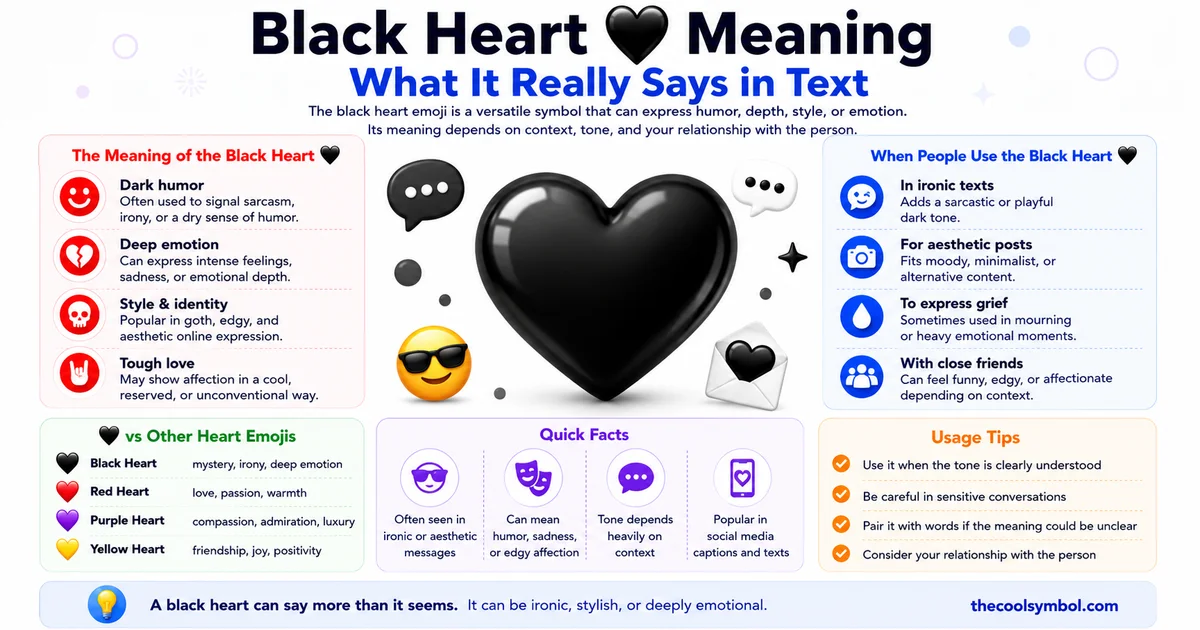
Someone sent you 🖤 and your first thought was: “Wait, are they mad at me?”
Or maybe: “Is this a goth thing?”
Or: “Why didn’t they just send the red one?”
The black heart emoji is one of the most misread symbols on the internet. The same emoji means “I’m grieving” in one chat, “this song slaps” in another and “my soul matches my eyeliner” in a third. Context decides everything.
This guide breaks down what the black heart actually means, where it came from, the modern subcultures that adopted it and the situations where sending it lands right versus the ones where it accidentally signals something dark.
The short answer: what 🖤 actually means
The black heart emoji carries three primary meanings depending on who’s using it.
- Aesthetic edge: minimalist, dark, cool, or rebellious style
- Grief or mourning: loss, sorrow, dark emotional moments
- Dark humor and irony: love expressed with a sarcastic or sardonic twist
None of those is the default. The black heart doesn’t have a single universal meaning the way the red one does. Its meaning is shaped by the platform, the sender’s age, the conversation topic and the visual context around it.
That ambiguity is exactly why it’s popular. People reach for it when the red heart feels too sincere, too soft, or too obvious.
Where the black heart emoji came from
The black heart is younger than most heart emojis. Unicode officially added it in 2016 as part of Unicode 9.0. Before that, people had to type out the heart symbol (♥) in black text or use a textured version on platforms that supported it.
When it dropped, the meaning was wide open. Unicode itself describes it neutrally as just a “black heart.” No emotion was officially assigned. That’s rare for an emoji and it created space for users to define the meaning organically.
Within a year of release, three things happened. Mourning communities adopted it as a sign of remembrance. Goth and emo accounts on Instagram started using it as part of their aesthetic. And K-pop and hip-hop culture absorbed it as a marker of cool detachment.
By 2020, the black heart had layered meanings that you couldn’t separate cleanly. It became one of the most context-dependent emojis on any keyboard.
Meaning 1: aesthetic, edge and cool detachment
If you scroll through Instagram, TikTok, or Tumblr, you’ll see the black heart used in bios, captions and comments more than almost any other heart color outside of red. The usage pattern is consistent: it signals a vibe, not an emotion.
The black heart is associated with:
- Minimalist aesthetic accounts (clean photos, monochrome, fashion)
- Goth, emo, alt and dark academia subcultures
- Hip-hop and trap music culture
- Streetwear and skate communities
- Anyone who thinks 🤍 is too soft and ❤️ is too earnest
When someone puts the black heart in their bio or drops it three times in a row on a photo, they’re not telling you about their feelings. They’re telling you about their visual identity. It’s emotional shorthand for “I am cool and a little detached, but I appreciate this.”
Gen Z uses it this way more than any other generation. If a Gen Z friend leaves a black heart on your post, it’s the equivalent of a slow nod of approval. Not a hug. Not a kiss. A nod.
Visual: what the black heart actually means by context
Same emoji, dramatically different interpretation depending on where and how it shows up.
The same emoji on a memorial post and on a streetwear photo means completely different things. The context around the heart does almost all the meaning-making work.
Meaning 2: mourning, grief and remembrance
After a public tragedy, the comment sections fill with black hearts. Celebrity deaths. Mass shootings. Natural disasters. Memorial posts. The black heart became the digital equivalent of wearing black to a funeral.
This usage exploded around 2017-2018 when several high-profile deaths in music (Lil Peep, Avicii, Mac Miller) had communities organizing around the black heart in fan posts. It became a way to express grief without writing a paragraph. One symbol said, “I’m sad. I’m with you. I’m not going to make this about me.”
Today, the grief use is well understood enough that most people read it correctly in context. If you see a black heart on a post about loss, illness, or hard times, it’s almost always condolences.
This is also why sending it to someone in a normal conversation can accidentally feel grief-adjacent. If you text a friend “how was the meeting?” and they reply with just a black heart, you might wonder if something bad happened. The grief association is strong enough that the emoji alone, without context, can read as ominous.
Meaning 3: dark humor and ironic affection
The third major use is more recent and harder to pin down: dark humor.
When someone posts “my therapist says I have unresolved trauma but I think I’m just built different 🖤” the heart isn’t expressing love or grief. It’s signaling that the sender knows the situation is grim, finds it funny anyway and wants you to laugh with them.
This use pattern is everywhere on Twitter/X, TikTok and Reddit. Dark academia, mental health humor accounts, true crime communities and burnout culture all lean on the black heart as a marker of “this is bleak but we’re handling it.”
The tone is sardonic, not sad. There’s a difference between “my dog died” with a black heart (genuine grief) and “slept 3 hours, didn’t eat, working a 12-hour shift, doing great” with a black heart (dark humor). Both use the same emoji. Both work.
Want to copy 🖤 or any other heart variant for your next post? Browse the full heart symbols collection here →. Every heart color, every shape, ready to copy and paste anywhere.
When to send the black heart (and when to skip it)
The black heart is high-risk, high-reward. It can land beautifully or get misread completely. Use it carefully.
Good times to send it
- Reacting to a friend’s aesthetic photo on Instagram or VSCO
- Commenting on a song, album cover, or moody outfit photo
- Expressing condolences when words feel like too much
- Replying to your own dark-humor post or someone else’s
- Marking something cool with restraint instead of the louder ❤️
Times to skip it
- Romantic contexts where you want sincerity (use red, pink, or red sparkling)
- Replying to actual good news (it reads as dismissive or unenthusiastic)
- Professional or formal chats (it doesn’t match the register)
- First-time conversations with someone who doesn’t know your style yet
- Messaging older relatives who might read it as grief by default
If you’re between two heart colors, ask yourself what the receiver will read first. If their default interpretation is grief, that’s the meaning you’re sending. Pick a different color.
Black heart vs red heart: the big difference
The cleanest way to understand the black heart is to compare it directly to its older sibling.
The red heart ❤️ stands for love. Direct, sincere, classic affection. It carries weight and the meaning is universal. Send it and you’re saying something earnest.
The black heart stands for everything sideways. Aesthetic, irony, grief, cool detachment. The meaning shifts with context and the same emoji can mean three different things on three different posts.
If you want a deeper breakdown of how the red heart works and why it’s so different from the black one, here’s the complete guide to the red heart emoji’s meaning and history, which covers its color symbolism, modern usage and where the heart shape originally came from.
4 mistakes people make with the black heart
1. Using it in a romantic context
Sending the black heart to a new romantic partner usually backfires. They’ll read it as cold, disinterested, or even ominous. The red heart, pink heart, or sparkling heart are all safer. Save the dark one for established relationships where your partner already knows you use it as a style choice.
2. Sending it after good news
If your friend texts “I got the job!” and you reply with a black heart, they’ll wonder why you’re being weird about it. The black heart doesn’t pair well with celebration. Use 🎉, ❤️ or ✨ for genuinely good news.
3. Reading too much into receiving one
If someone leaves a black heart on your photo, it usually doesn’t mean anything dark. It means they liked the photo and wanted to react with something other than the default. Don’t spiral. Most black hearts on social media are aesthetic, not emotional.
4. Sending it to older relatives
Anyone over 45 typically reads the black heart as “something is wrong.” If your aunt sees one in your text, she might call to check if you’re okay. Match the heart color to the receiver’s emoji literacy.
Wrapping up
The black heart is one of the most flexible emojis in modern use. It can mean aesthetic detachment, deep grief, ironic affection, cool appreciation, or all four in the same week depending on what you’re posting about.
Read the context before you read the heart. Match the receiver’s style. And remember that one black heart can carry the same weight as a paragraph of words when used in the right moment.