
What Does the Red Heart ❤️ Really Mean? Symbolism & When to Use It
By The Cool Symbol Team on 2026-05-23
You typed out a long message to someone. Re-read it. Deleted everything. Sent ❤️ instead.
That tiny red heart did a lot of heavy lifting in that moment. It said something words couldn’t, or didn’t need to.
And that’s the strange thing about the red heart emoji. Everyone uses it. Almost nobody stops to think about what it actually means or why it hits differently than the pink one, the orange one, or the purple one. It’s the default love symbol of the internet, but the meaning shifts depending on who’s sending it and who’s receiving it.
This guide breaks down what the red heart really stands for, where it came from, how its meaning has shifted across generations and the situations where sending it lands perfectly versus the ones where it backfires.
The short answer: what ❤️ actually means
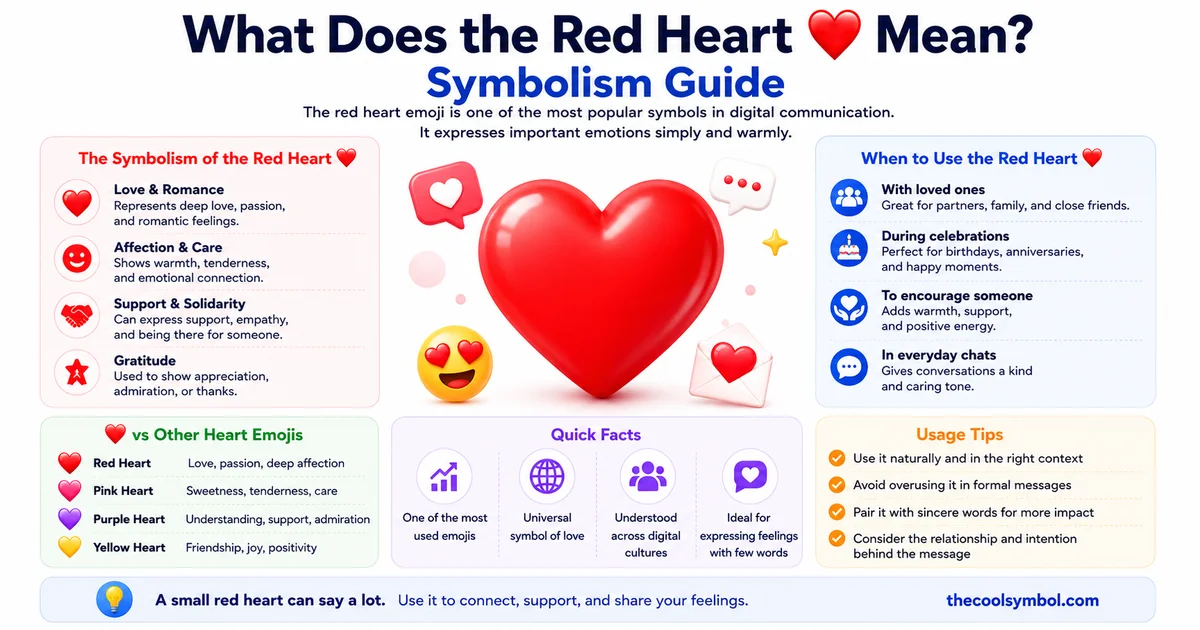
The red heart emoji means classic, unconditional love. Romance. Deep affection. The kind of love you’d put on a Valentine’s card without thinking twice.
It’s the most universal of all the heart emojis. No subtext, no irony, no inside joke. When someone sends you a red heart, they’re telling you they care about you in the simplest, most direct way the internet has invented.
But that simplicity is exactly what makes it complicated to use.
Because the heart carries weight. Send it to a friend after they share good news and it reads as warm support. Send it to a colleague after a work email and it reads as wildly inappropriate. Same emoji, completely different temperature.
Where the red heart symbol came from
The heart shape you know today isn’t shaped like a real human heart. Real hearts are blobby, lopsided and look a bit like a clenched fist with tubes coming out. So where did the cartoon heart actually come from?
Nobody has a perfect answer, but historians have a few solid theories.
Theory 1: An extinct plant
In ancient Cyrene (a Greek colony in modern-day Libya), there was a plant called silphium. Its seedpod was shaped almost exactly like the modern heart symbol. The Romans used silphium as a contraceptive, which linked the shape to love and sex. The plant was harvested to extinction by 100 AD, but the symbol stuck around.
Theory 2: Medieval illustrators couldn’t draw hearts
By the 13th and 14th centuries, the heart shape started showing up in European art tied to romantic love. Medieval doctors had vague ideas about what a heart looked like and illustrators simplified it into the rounded shape you’d recognize today. Once it appeared in love poetry and tarot cards, it stuck.
Theory 3: It was always about ivy leaves and pomegranates
Some scholars argue the heart shape was borrowed from ivy leaves (a symbol of fidelity in ancient Greece) or split pomegranates (associated with passion and fertility). Both fit the rounded, pointed shape.
Whichever theory is right, by the time playing cards spread across Europe in the 15th century, the heart was already firmly tied to love. Then came Valentine’s cards in the 1800s, candy hearts and eventually a red pixelated heart on a Japanese phone in the late 1990s. That’s where the emoji was born.
Why red, not blue, not green, not gold
Red is the color of blood. It’s also the color your face turns when you’re embarrassed, excited, or attracted to someone. Red signals passion, urgency and physical reaction across pretty much every culture on Earth.
When the original emoji designers at SoftBank and DoCoMo picked a color for the heart in 1999, red was the obvious choice. It matched what people already drew on Valentine’s cards. It matched the candy hearts. It matched the cliché.
Every other heart color came later as a variation: black for grief or edgy aesthetics, white for purity, purple for fandoms, green for jealousy or eco-friendly love. The red one is the original. It’s the parent emoji that every other heart color is reacting to.
Want to explore every heart symbol and emoji in one place? Browse the full heart symbols collection → and copy any one to use anywhere on the web.
How people actually use the red heart in 2026
The textbook meaning is one thing. The real-world meaning shifts depending on age, platform and who’s sending it. Here’s how the red heart lands in different situations.
In a romantic relationship
This is home territory. Sending the red heart to a partner is a signal of genuine affection and it’s read exactly as intended. Couples often build little patterns around it: a heart at the end of every goodnight text, a single ❤️ as a response when words feel like too much.
If you’ve been dating someone for a while and they suddenly stop sending hearts, you’ll feel it. That’s how loaded this emoji is in romantic contexts.
Between close friends
Mostly safe, but context matters. Sending a red heart to a best friend after they vent about a bad day is sweet and supportive. Sending it to a friend you haven’t spoken to in 6 months can come across as overly intense.
Gen Z women use the heart icon freely between friends. Older generations and men of all ages use it more sparingly between friends, which is why a guy sending one to a female friend can sometimes get misread as romantic interest even when it isn’t.
Family chats
Universally accepted and very common. Parents send the red heart to kids constantly. Siblings send it after good news. Grandparents who only learned how to use emojis last year tend to send it as a full reply by itself.
On social media posts
This is where the meaning thins out. A red heart in the comments of someone’s Instagram post is closer to a digital thumbs-up than a declaration of love. It means “I see you, I support this, here’s a small gesture.” The bar for sincerity is lower because everyone’s leaving hearts.
In work or professional chats
Almost always wrong. Hearts on Slack, in email signatures, or in LinkedIn DMs feel out of place because the relationship doesn’t justify the intimacy the emoji carries. Use 👍, 🎉, or 🙌 in professional settings instead.
The exception: creative industries, small teams that have become close and women-led workplaces where heart emojis have become a normal part of the chat culture.
Red heart vs other heart colors: when to switch
If you’ve ever wondered whether to send the red heart or a different colored heart, here’s the quick decoder.
❤️ Red Heart
Classic love, romance, deep affection. The default. Use it when you mean it sincerely and the relationship can support that weight.
🧡 Orange Heart
Warmth, friendship, half-love. People use it when the red one feels like too much. Common in supportive replies and friendly affection.
💛 Yellow Heart
Happiness, friendship, pure platonic care. On Snapchat, this one shows up when you’re each other’s #1 best friend.
💚 Green Heart
Friendship, jealousy (sometimes), nature, Irish identity. Context-dependent.
💙 Blue Heart
Trust, loyalty, calm affection. Often used between male friends because it feels less romantic than red.
💜 Purple Heart
Started as a sign of compassion. Then BTS fans claimed it. Now it carries strong K-pop associations alongside its older meaning of understanding and support.
🖤 Black Heart
Dark humor, grief, edgy aesthetic, sometimes love with a goth twist. Rarely literal.
🤍 White Heart
Purity, peace, or platonic love. Popular on minimalist aesthetic accounts.
💗 Growing Heart
Affection that’s building. Often used to show fondness that’s getting stronger.
💓 Beating Heart
Excitement, butterflies, crush energy.
If you’re trying to express love without the full weight of the red heart, drop down to 🧡 or 💛. If you want to keep romance specific to one person, keep ❤️ reserved for them and use other colors with everyone else. That’s a quiet but meaningful piece of emoji etiquette.
How the red heart lands in different cultures
Most cultures read the red heart as love. The variation is mainly in how freely people send it.
In the US and most of Europe, sending the heart icon between non-romantic friends is normal and common. In parts of South Asia and the Middle East, sending a red heart to someone of the opposite gender (especially as a non-family member) can carry stronger romantic implications than the sender intended.
Japan, where the emoji was born, treats the red heart more sparingly than the West. Japanese users often use lighter heart variants or sparkle hearts to express affection without the full romantic load.
In China, where Western emoji meanings have been adopted but adapted, the red heart is sometimes paired with specific numbers (like 520, which sounds like “I love you” in Mandarin) to add layered meaning.
If you’re messaging someone from a culture different from your own, the safest move is to mirror what they send first. If they lead with hearts, you can return them. If they keep it neutral, stay neutral.
4 mistakes people make with the red heart
1. Sending it too early in a romantic context
A red heart on day 3 of dating someone is intense. Most people downshift to 🧡, 💛, or just no heart at all until the relationship is past the casual stage. The red one carries a specific weight you don’t want to deploy by accident.
2. Using it in professional chats
Even if your workplace is casual, a heart emoji on Slack to a coworker can read as unprofessional or, worse, inappropriate. Stick to reaction emojis like 👍, ✅, or 🎉 unless the team has clearly normalized hearts.
3. Replying to bad news with a heart
This one trips people up. Someone says “my grandmother passed away” and the instinct is to send ❤️. It’s well-meaning but it can come across as flat or even tone-deaf. A short message like “I’m so sorry, sending you love” with a heart at the end lands much better because the symbol supports your words instead of replacing them.
4. Sending it to someone you barely know
Dropping a heart on a stranger’s Instagram post is normal social currency. Sending one in a DM to someone you’ve exchanged 4 messages with is not. The emoji implies a level of closeness that needs to actually exist.
Looking for the right heart for the right moment? Copy any heart symbol or emoji here →. Works on Instagram, WhatsApp, Discord and anywhere else you type.
What the red heart doesn’t mean
Worth clearing up a few myths.
The red heart doesn’t always mean someone is in love with you. People send it as warmth, support, or even just a digital smile. Don’t read declarations of love into a heart from a friend or family member.
It isn’t a guaranteed sign of romantic interest either. If you’re trying to figure out whether someone likes you romantically, the red heart on its own is weak evidence. Look at the pattern: do they only heart you, or do they heart everyone? Do they pair it with personal messages, or just leave it on public posts?
And it isn’t only for couples. Friends, family and casual acquaintances all send it. The meaning bends to fit the relationship, not the other way around.
Frequently Asked Questions
What does the red heart mean from a girl?
Depends entirely on context. From a girlfriend, it means love. From a friend, it means support or affection. From a girl you’ve just started talking to, it might mean she’s interested, or she might just be the type who sends hearts to everyone. Look at how she uses it with other people before reading into it.
Is the red heart emoji flirty?
Not inherently. The heart becomes flirty when it’s used sparingly between two people who already have romantic tension. In a group chat with 10 friends, the same emoji is neutral. Flirty intent comes from context and pattern, not the emoji itself.
What’s the difference between ❤️ and 💖?
The red heart is steady, classic love. The sparkling heart 💖 is more playful, excited, or romantic in a giddy way. Couples use 💖 when they’re feeling cute. The red one is more reserved and grounded.
Can I send a red heart to a friend?
Yes, with some judgment. Sending it to a close friend after good news, a tough moment, or just as a goodnight is normal. Sending it out of nowhere to a casual friend can feel like overreach. Match the closeness of your relationship to the weight of the emoji.
Why do some people use ❤️ instead of saying “I love you”?
Hearts let you express love without committing to the full sentence. They’re softer, lower-stakes and easier to send across cultures where saying “I love you” out loud is uncommon. For a lot of people, the red heart is the texting equivalent of a quick hug. It says what you’d say if words felt like too much.
Wrapping up
The red heart looks simple, but it carries one of the longest histories of any digital symbol you use every day. It’s the descendant of medieval love poetry, ancient plant seedpods and a small red square drawn on a Japanese phone screen in 1999.
Use it when you mean it. Match it to the relationship. And remember that a heart from one person can mean a thousand different things depending on who they are to you.