
Broken Heart 💔 Meaning: When and Why People Send This Emoji
By The Cool Symbol Team on 2026-06-02
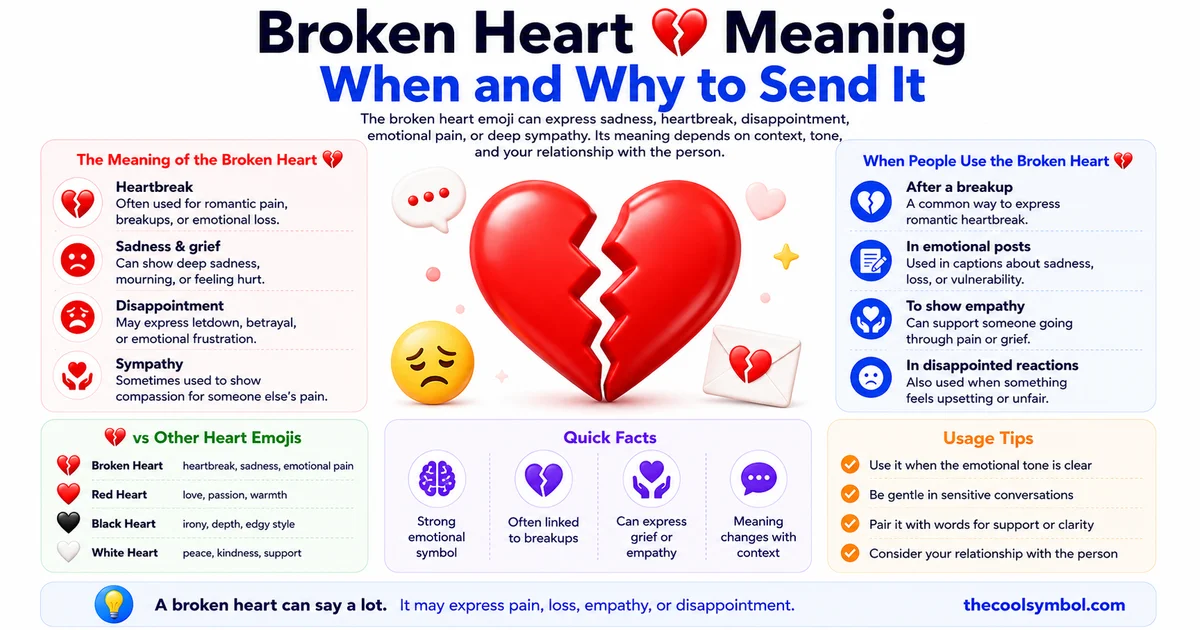
The broken heart emoji is the one you hope you never have to send. The little red heart split down the middle, cracked clean in two.
And yet people send it constantly. After a breakup. After a loss. After their team loses a game. After a song hits too hard. After a meme that’s a little too real. The same cracked heart covers genuine grief and total melodrama, sometimes in the same conversation.
That range is what makes it interesting. The broken heart is one of the oldest emotional symbols humans have. The emoji version carries all of that weight while also being used to react to a burnt pizza.
This guide breaks down what the broken heart emoji actually means, where the broken-heart idea came from, the modern ways people use it and the moments where sending it lands exactly right.
The short answer: what the broken heart means
The broken heart emoji means emotional pain, but the intensity ranges enormously depending on context.
- Genuine heartbreak: breakups, loss, grief, deep disappointment
- Sympathy: feeling someone else’s pain with them
- Dramatic exaggeration: playful over-reaction to small letdowns
- Emotional overwhelm: when something is so good or so sad it hurts
Unlike the red heart that means love or the yellow heart that means friendship, the broken heart is the one heart emoji built entirely around pain. The only question is how serious that pain is. The surrounding context answers it.
Where the broken heart idea came from
The broken heart is far older than any emoji keyboard. The idea that emotional pain can crack the heart in two goes back thousands of years.
Ancient cultures already linked the heart to emotion. When the heart became the universal symbol of love in medieval Europe, the cracked or pierced heart naturally followed as the symbol of love lost. A heart pierced by an arrow, a heart split down the middle, a heart wrapped in thorns. All of these appeared in art, poetry and religious imagery as ways to show love turned to suffering.
If you’re curious how the heart shape became the symbol of love in the first place, here’s the full history of the heart symbol tracing it from an ancient plant through medieval poetry to the modern emoji keyboard.
The phrase “broken heart” itself appears across centuries of literature, music and everyday speech. By the time emojis arrived, the cracked-heart image was already universal. The emoji just digitized a symbol humans had been drawing for hundreds of years.
The broken heart emoji was added to Unicode in 2010 as part of the original emoji wave and it was an instant staple. It filled an emotional gap no other emoji covered: the specific feeling of hurt.
The modern meanings of the broken heart emoji
In everyday use, the broken heart splits into a few distinct meanings. The context around it decides which one is in play.
Genuine heartbreak
The original and most serious use. After a breakup, a rejection, or the end of something that mattered, the broken heart says what’s hard to put into words. It’s a way to signal real emotional pain without writing a paragraph about it.
Grief and loss
When someone dies or a community suffers a tragedy, the broken heart appears alongside condolences. It expresses shared sorrow. On memorial posts, news of a loss, or tributes, the broken heart reads as genuine mourning.
Sympathy and solidarity
When a friend shares bad news (a job loss, a sick pet, a hard week), sending a broken heart means “my heart hurts with yours.” It’s an act of emotional company, telling the person they’re not alone in the feeling.
Playful exaggeration
This is where the broken heart gets fun. People use it to dramatize small disappointments. “The cafe was out of oat milk 💔.” “My phone died at 2% 💔.” Here the broken heart is comedy, a wink that says “this is a tragedy” while everyone knows it isn’t. The exaggeration is the joke.
Overwhelm from intensity
Sometimes the broken heart marks emotion that’s almost too much to handle, even good emotion. A reunion video. A soldier coming home. A dog waiting for its owner. People comment a broken heart not because they’re sad, but because the feeling is so strong it aches. “This broke me” is the energy.
Visual: how serious is that broken heart?
The same emoji can mean devastating grief or pure comedy. Here’s how to read which one you’re looking at.
The words around the broken heart tell you everything. Serious topic plus no humor means real pain. A burnt-toast caption means it’s a joke. Read the context first, react second.
Need to copy the broken heart or any other heart emoji? Browse the full heart symbols collection here →. Every heart, from whole to cracked to every color, ready to copy and paste anywhere.
When to send the broken heart (and when to skip it)
Good times to send it
- Comforting a friend going through a breakup or hard time
- Expressing genuine sympathy after someone shares a loss
- Reacting to emotional content that genuinely moved you
- Playfully dramatizing a small disappointment with people who get the joke
- Telling someone you miss them in a soft, vulnerable way
Times to skip it
- Reacting to genuinely good news (it sends a confusing mixed signal)
- Professional contexts where emotional emojis feel out of place
- Joking about a serious tragedy where humor would hurt
- Early dating when you don’t want to seem overly dramatic
The biggest rule: match the intensity to the moment. A playful broken heart on someone’s real grief reads as careless. A deeply serious broken heart over spilled coffee reads as strange. Calibrate to the situation.
Broken heart vs other heart emojis
The broken heart is the outlier in the heart family. Almost every other heart is about love or warmth. This one is about its absence.
The black heart, which carries a moody and sometimes mournful tone, is the closest emotional neighbor, but it’s about detachment and aesthetic darkness rather than the specific sting of heartbreak.
The white heart with its meaning of peace and quiet sympathy is often the gentler choice for condolences, where the broken heart might feel too raw or dramatic for the moment.
And the purple heart with its ties to fandom and emotional support sometimes pairs with the broken heart in fan communities mourning a celebrity or a beloved character.
When you want to express pain specifically, the broken heart is the only one built for the job. The others can hint at sadness, but the cracked heart names it directly.
4 mistakes people make with the broken heart
1. Sending it as a reaction to good news
If a friend posts “I got engaged!” and you reply with a broken heart, they’ll be confused or hurt. The broken heart signals pain. For happy news, use a red heart, celebration emoji, or sparkles instead.
2. Using it playfully on someone’s real pain
The playful broken heart is fine for your own small disappointments. Using that same joking tone on someone else’s genuine heartbreak comes across as dismissive. When the pain is real and theirs, drop the humor.
3. Overusing it until it loses meaning
If you send a broken heart over every minor inconvenience all day long, it stops carrying weight. Then when something genuinely hurts, the emoji has nothing left to say. Save the broken heart for moments that actually earn it.
4. Misreading a playful one as serious
If someone sends “ran out of coffee 💔” they are joking. Responding with deep concern and “are you okay, do you want to talk?” misreads the room. Check whether the surrounding words are light or heavy before you react.
Wrapping up
The broken heart emoji carries one of the oldest human feelings in one of the newest formats. The cracked heart has meant lost love for centuries. The emoji version added a whole new range, from real grief to pure comedy.
Read the context. Match the intensity. Use it for genuine pain when words feel like too much, then for playful drama when everyone’s in on the joke. Just don’t send it when someone shares good news. And don’t joke with it on someone else’s real heartbreak.
One cracked heart, used at the right moment, says what a paragraph of words sometimes can’t.