
Indian Rupee Symbol ₹: How India Got Its Own Currency Sign in 2010
By The Cool Symbol Team on 2026-07-17
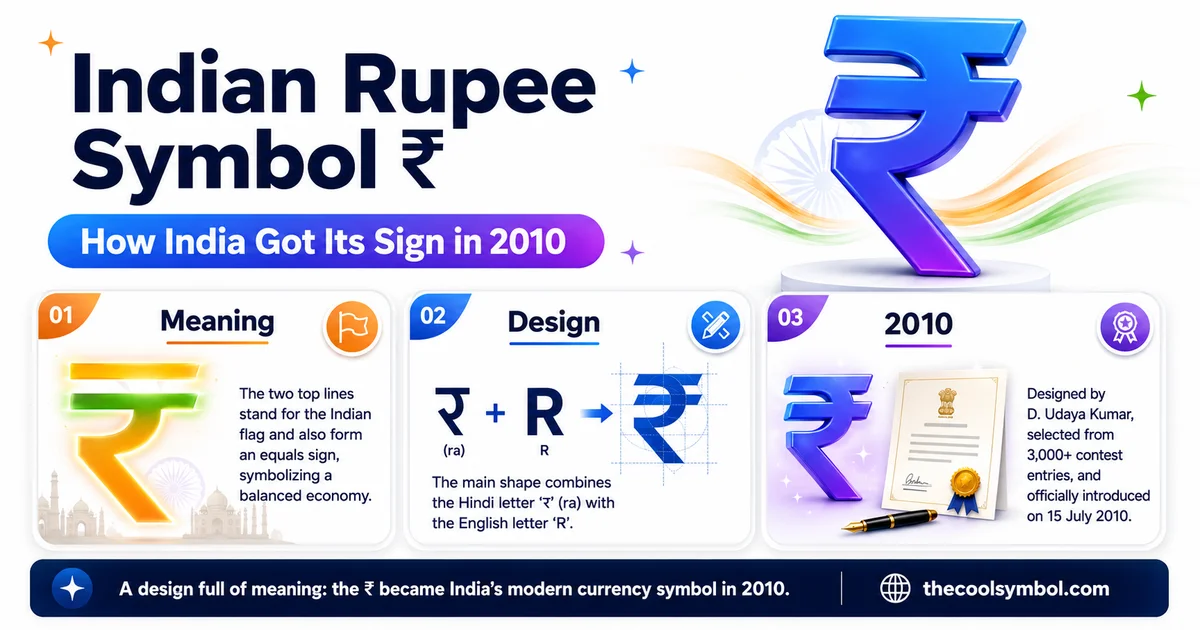
You see the ₹ symbol every day. It’s on price tags, menus, ATM screens and every online payment you make. It feels like it has always been there.
But it hasn’t. The ₹ symbol is quite new. It was born in 2010. Before that, India just used the letters “Rs” to show the rupee.
So how did India get its own money symbol? The answer is a nice story. The country held a big open contest. Anyone in India could enter. Thousands of people sent in their designs. And in the end, one young man’s idea won.
In this guide you’ll learn where the ₹ symbol came from, who made it, what its shape means and why India wanted its own sign in the first place. It’s a short and interesting story, told in easy words.
What India used before 2010
For a long time, India did not have a special symbol for its money. People just wrote “Rs” before the amount, like Rs 100. In Hindi, they wrote “रु”.
This worked, but it was not special. Lots of other countries also used “Rs” for their own money, like Pakistan, Sri Lanka and Nepal. So “Rs” did not really say “India.”
By 2010, India’s economy was growing fast. The country was becoming a big name in the world. A short letter code like “Rs” felt too plain for such a rising nation. India wanted a strong symbol of its own, just like the dollar and the euro have.
Think about how powerful a good money symbol can be. The dollar sign has a long and famous history, and people know it all over the world. India wanted that same kind of clear, proud identity for the rupee.
The big contest of 2009
In March 2009, the Indian government did something clever. Instead of picking a symbol behind closed doors, they held an open contest for the whole country.
The rules were simple. Any Indian citizen could send in a design. The government said the symbol should show Indian culture and values. It should feel Indian, but also work in the modern world.
The response was huge. More than 3,000 designs came in from people all across India. That’s thousands of citizens all trying to give their country a new symbol. From all of these, the judges picked just five as the best.
Then, in July 2010, the winner was chosen. And the story behind the winner is the best part.
The man who designed the ₹ symbol
The winning design was made by a man named D. Udaya Kumar. He was born in Tamil Nadu, in South India. At the time of the contest, he was a design student doing his PhD at IIT Bombay.
Udaya Kumar loved design and typography, which is the art of letters and shapes. So when the contest came up, he asked himself a simple question: what should a symbol for India look like?
His answer was smart. He decided to join two worlds into one shape. He took a letter from an Indian script and a letter from the English alphabet, then put them together. That idea became the ₹ symbol we use today.
For his winning design, Udaya Kumar was given a prize of 2,50,000 rupees. But the bigger reward was seeing his work used by more than a billion people every single day. Not many designers can say that.
What the ₹ symbol shape means
Every part of the ₹ symbol has a meaning. Once you know them, the design feels very clever.
It joins two letters
The main shape comes from two letters put together. One is the Devanagari letter “र” (ra), which is used in Hindi. The other is the English capital letter “R,” but without its straight standing line.
Why these two? The “ra” stands for India’s own language and culture. The “R” stands for the word “Rupee” and India’s link to the wider world. So the symbol shows both sides of India at once: its roots and its future.
The two lines at the top
Look at the top of the ₹ symbol and you’ll see two lines running across it. These lines do two jobs.
First, they stand for the Indian flag. The white space between the two lines is meant to be the white stripe of the tricolour. Second, the two lines look like an “equals” sign (=). This stands for a balanced economy, plus the idea of equality that India values.
There’s one more clever touch. The line across the top also matches the Shirorekha, the line that runs above the letters in Hindi writing. So the symbol feels truly Indian in its very shape.
The ₹ symbol, part by part
Here’s the whole symbol broken into simple parts, so you can see the meaning behind each one.
So the ₹ symbol is really three ideas in one small mark: India’s language, India’s link to the world and India’s flag. All packed into a shape you can draw in one go.
Want to copy the rupee symbol or find other currency and symbol signs? See the full symbol collection here →. Every money sign, from ₹ to $, € and £, ready to copy and paste anywhere you type.
How the symbol became official
Winning the contest was just the first step. To really work, the symbol had to get onto phones, computers and keyboards all over the world. That needed one more thing: Unicode.
Unicode is the system that gives every letter and symbol a code, so that computers everywhere can show it. Without a Unicode code, the ₹ symbol would not appear on screens or in text messages.
On 12 October 2010, the rupee symbol was added to Unicode. As Wikipedia’s page on the Indian rupee sign explains, this is what let banks, phones and websites start using ₹ in place of the old “Rs.” Once the code was in, the symbol spread fast.
Then, on 8 July 2011, the ₹ symbol started appearing on real coins and notes. From that point on, it was truly India’s own. In just about one year, the country went from “Rs” to a proud symbol used by everyone.
How the rupee symbol is used today
Today the ₹ symbol is everywhere in India. You see it on price tags, bills, bank statements, apps and shopping websites. It has fully replaced the old “Rs” in most places.
The symbol goes before the number, like ₹500. There is also a short code, INR, which stands for Indian Rupee. Banks and money exchanges use INR, mostly when they deal with other countries.
Most phone keyboards in India now have the ₹ symbol built in. On a computer, you can usually type it with a simple key combination. It’s as easy to use as any other letter now.
What the rupee symbol shows us
The rupee symbol is special because we know exactly how it was born. That’s rare for a money sign.
Most money symbols grew slowly over many years, by accident. But the rupee is like the euro symbol, which was also designed on purpose and shown to the world on one exact day. Both were planned, not grown by chance.
The rupee symbol also shows how a small design choice can carry a big meaning. Two simple lines can stand for a flag and an idea at the same time. A shape can hold a whole country’s story.
It’s a bit like how a small change from a single to a double line changes an arrow’s meaning. Tiny marks can say a lot. In the rupee symbol, every line and curve was picked with care to mean something about India.
3 things people get wrong about the ₹ symbol
1. That it’s very old
The ₹ symbol feels old because we see it so much. But it’s actually young. It was only made in 2010. Many people using it today are older than the symbol itself.
2. That it’s just the letter R
It looks a bit like an R, but it’s more than that. It joins the Hindi letter “ra” with the English “R.” It mixes two scripts into one shape on purpose.
3. That the lines are just for looks
The two lines at the top are not just design. They stand for the Indian flag and an equals sign for a balanced economy. Every part has a reason.
Wrapping up
The ₹ symbol is one of the newest money signs in the world, plus one of the most thoughtful. Before 2010, India just used “Rs.” Then a nationwide contest, more than 3,000 entries and one clever design by D. Udaya Kumar gave the country its own sign.
Its shape joins the Hindi letter “ra” with the English “R.” Its two top lines stand for the Indian flag and a balanced economy. It went into Unicode in October 2010 and onto coins in 2011. It has been part of daily life ever since.
So the next time you see a ₹ before a price, remember it wasn’t always there. It’s a young symbol, made with care, that carries a whole country’s pride in a single mark.