
The History of the Dollar Sign $: Why It Looks Like an S with a Line
By The Cool Symbol Team on 2026-07-05
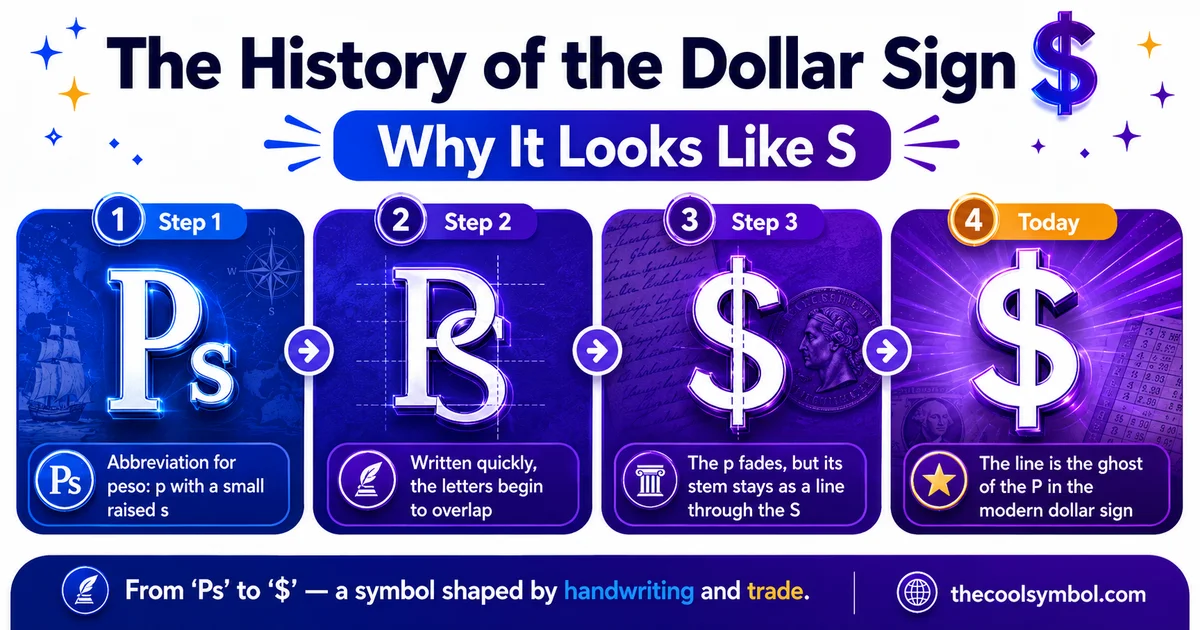
Look at the dollar sign for a second. It’s an S with a line through it. But the word “dollar” has no S sound at the start, yet the currency isn’t shaped like an S. So why does the most famous money symbol in the world look the way it does?
The answer is a genuine historical mystery, since the real story has nothing to do with America, even though most people assume the $ was invented in the United States. It wasn’t. The symbol is older than the country that made it famous.
There are several competing theories, one widely accepted and a few colorful ones that turned out to be myths. The truth traces back to Spanish silver coins, busy accountants and a bit of handwriting that got faster and faster until two letters merged into one.
This guide walks through where the dollar sign really came from, why it has that distinctive line (or sometimes two), the theories that got debunked and how a Spanish coin ended up giving the world its money symbol.
The short answer
The most widely accepted explanation is surprisingly ordinary. The dollar sign evolved from a handwritten abbreviation for the Spanish peso.
In the late 1700s, the Spanish silver dollar (called the peso, or “piece of eight”) was the most trusted currency in the Americas. Accountants and traders abbreviated it as “Ps,” written as a capital P with a small superscript s. As people wrote it quickly, over and over, the s drifted on top of the p, until eventually the two letters merged into a single mark: an S-like shape with a vertical stroke through it. That mark became the $.
So the line isn’t decorative. It’s the ghost of the letter P, left behind when the peso abbreviation collapsed into one symbol. The dollar sign is really a very old, very fast piece of shorthand.
It starts with the Spanish dollar
To understand the symbol, you have to understand the coin behind it.
The Spanish dollar, formally the “real de a ocho” or “piece of eight,” was a large silver coin first minted after a Spanish coinage reform in 1497. It was worth eight Spanish reales, which is where “piece of eight” comes from. And because of its consistent size and silver purity, it became the first true world currency by the 16th century, trusted and traded across Europe, the Americas and the Far East.
In colonial America, the Spanish dollar was so trusted that it circulated as everyday money. When the United States created its own dollar with the Coinage Act of 1792, it literally defined the new US dollar to match the weight and silver content of the Spanish coin. The Spanish dollar stayed legal tender in the US until 1857.
This is the key fact most people miss. The word “dollar” and the money it described were Spanish first, American second. So the symbol for it grew out of Spanish currency, not American design.
How “Ps” became “$”
The peso abbreviation theory is the one most historians accept, with the paper trail supporting it.
A study of late 18th and early 19th century manuscripts shows the change happening on the page. Writers abbreviated the peso as “Ps.” Over time the s crept upward and over the p, the loop of the p faded, and what remained was a stroke through an S. According to Britannica’s history of the dollar sign, this peso abbreviation is the most widely circulated and accepted origin theory for the symbol.
There’s even a famous piece of evidence. Oliver Pollock, a wealthy Irish trader and a financial supporter of the American Revolution, wrote a letter in 1778 in which his “ps” abbreviation runs together into something that looks almost exactly like the modern dollar sign. It’s one of the earliest clear glimpses of the symbol taking shape.
The symbol first appeared in print around the turn of the 19th century and was in wide use by the time the first US paper dollars circulated. By then, the Spanish coin that inspired it was on its way out, but the shorthand for it had taken on a life of its own.
How the symbol evolved, step by step
The clearest way to see it is as a sequence, from two separate letters to one merged mark.
Seen this way, the dollar sign isn’t mysterious at all. It’s two letters that got written together so many times they fused into one. The line you see every day is a leftover stroke from a word most people have forgotten was ever there.
Want to copy the dollar sign or browse other currency and symbol designs? Explore the full symbol collection here →. Every currency mark, from $ to €, £ and ₹, ready to copy and paste anywhere you type.
One line or two? The two versions of the $
You may have noticed the dollar sign sometimes has one vertical line and sometimes two. Both are correct, with a reason behind each.
The single-bar $ is the standard for the US dollar and most currencies that use the symbol. The double-bar version has its own history. Many trace it to the Pillars of Hercules, the two columns wrapped in S-shaped ribbons that appear on the back of the Spanish dollar coin. In this theory, the two pillars became the two vertical strokes, while the ribbon became the S.
Today the two-bar version is called the “cifrao” and shows up mainly in Portuguese-language contexts and some older serif typefaces. Unicode treats both as stylistic variants of the same character, so which one appears often just depends on the font you’re using. If you want the classic look, the single bar is the safe default.
The theories that turned out to be myths
Because the true origin was uncertain for so long, several colorful theories grew up around the dollar sign. Most have been discredited, but they’re worth knowing.
The “US monogram” myth
The most popular myth says the $ is a U stacked on top of an S, for “United States,” with the bottom of the U worn away to leave two vertical lines. It’s a satisfying story because it makes the symbol uniquely American. But there’s no documentary evidence for it, since the dollar sign was already in use before the United States even existed. The timing alone rules it out.
The “pieces of eight” number 8 myth
Another theory says the $ is a stylized version of the numeral 8, since the Spanish dollar was a “piece of eight.” It sounds plausible, but no documents have ever surfaced showing the number 8 used to represent the coin. Britannica and others treat it as a popular idea that lacks evidence.
The “units of silver” myth
A related idea claims the U and S stood for “units of silver.” This runs into the same problem: no evidence, while the symbol’s real roots in the peso abbreviation are much better documented. It’s a neat backronym, invented after the fact.
The pattern here is common with symbols. Once the real origin is forgotten, people invent tidier stories that feel meaningful. The truth (a rushed accounting shorthand) is less romantic but far better supported.
What the dollar sign teaches about symbols
The dollar sign is a perfect example of how symbols really come to be. Nobody sat down and designed it. It emerged from repeated use, accident and speed, then hardened into a fixed shape everyone recognizes.
This is how most enduring symbols work. They start as something practical and get their meaning layered on later, the same way arrow symbols evolved from a simple directional mark into a whole language of meaning, or the way even a single stroke can change a symbol’s sense entirely.
You see the same principle in how a single versus double arrow carries different weight in math and logic, where a tiny change in the strokes shifts the whole meaning, just as the one-bar and two-bar dollar signs carry their own separate histories.
And symbols keep gathering meaning over centuries. A shape born as accounting shorthand can end up standing for wealth, ambition and value itself, much like the shooting star grew from a simple image into a symbol of wishes and dreams. The shape stays simple while the meaning grows rich.
The dollar sign beyond money
The $ has escaped the world of currency and picked up a surprising range of other jobs.
- Programming: the $ marks variables in many languages, from BASIC to Perl and modern scripting
- Slang and style: people swap an S for a $ to signal money, wealth or a hip-hop aesthetic in names and brands
- Spreadsheets: the $ locks a cell reference in tools like Excel and Google Sheets
- Regular expressions: the $ marks the end of a line in search patterns
- Wealth and value: the symbol alone now signals money, cost or richness, no numbers needed
A symbol that began as a merchant’s shorthand for a Spanish coin now shows up in code, culture and design. That reach is a sign of just how deeply the dollar sign has embedded itself in the modern world.
3 common myths to stop believing
1. That the US invented the dollar sign
The symbol grew from the Spanish peso abbreviation and was in use before the United States existed. It’s Spanish in origin, not American, even though the US made it globally famous.
2. That the line stands for the pillars or the letter U
In the most accepted theory, the vertical line is the leftover stem of the letter P from the “Ps” peso abbreviation. The pillars theory explains the two-bar variant, but the everyday single-bar line traces back to that P.
3. That there’s one settled, certain origin
While the peso theory is the most accepted and best documented, the dollar sign’s exact evolution is still debated. Anyone who tells you the origin is 100% certain is overstating it. The honest answer is “most likely the peso abbreviation.”
Wrapping up
The dollar sign looks like an S with a line because it started as “Ps,” a rushed abbreviation for the Spanish peso, written so often that the two letters merged into one. The line is the ghost of the P. The symbol is Spanish in origin, older than the United States, spreading with the Spanish silver dollar that once served as the world’s currency.
The tidier stories, a U over an S for United States, a stylized figure 8, units of silver, are myths invented after the real origin faded from memory. The documented trail points to the humble peso abbreviation.
Next time you write a dollar sign, you’re drawing a 250-year-old piece of accounting shorthand for a Spanish coin. Not bad for an S with a line through it.