
Euro Symbol € Origin: The Story Behind Europe's Currency Sign
By The Cool Symbol Team on 2026-07-10
Most money symbols are very old. The dollar sign and the pound sign grew slowly over hundreds of years. Nobody sat down and drew them on purpose.
The euro symbol is different. It’s brand new, made on purpose. A group of people picked how it should look, tested it with the public and then showed it to the world on one exact day.
That makes the euro one of the only money symbols in history with a real birthday. And the little details in its shape, the round curve and the two lines through it, were all chosen for a reason.
In this guide you’ll learn where the euro symbol came from, what its shape really means, who designed it and why its true creator is still a bit of a mystery. It’s a short, interesting story, told in plain words.
A money symbol with a real birthday
Here’s the first surprise. The euro symbol has an exact birthday: 12 December 1996.
On that day, the European Commission showed the new symbol to the public for the first time. This was a big deal, because the euro money itself did not even exist yet. The symbol came first, then the coins and notes came later.
The euro started as digital money for banks on 1 January 1999. The actual coins and notes that people could hold arrived on 1 January 2002. So by the time you could spend a euro, its symbol was already a few years old and ready to go.
This is very unusual. Most currency symbols were never designed at all. They just formed on their own as people wrote quickly over many years. The euro is one of the few that was planned from the start.
What the euro symbol shape means
Every part of the euro symbol was chosen to mean something. Once you know the parts, the whole thing makes sense.
The round shape comes from a Greek letter
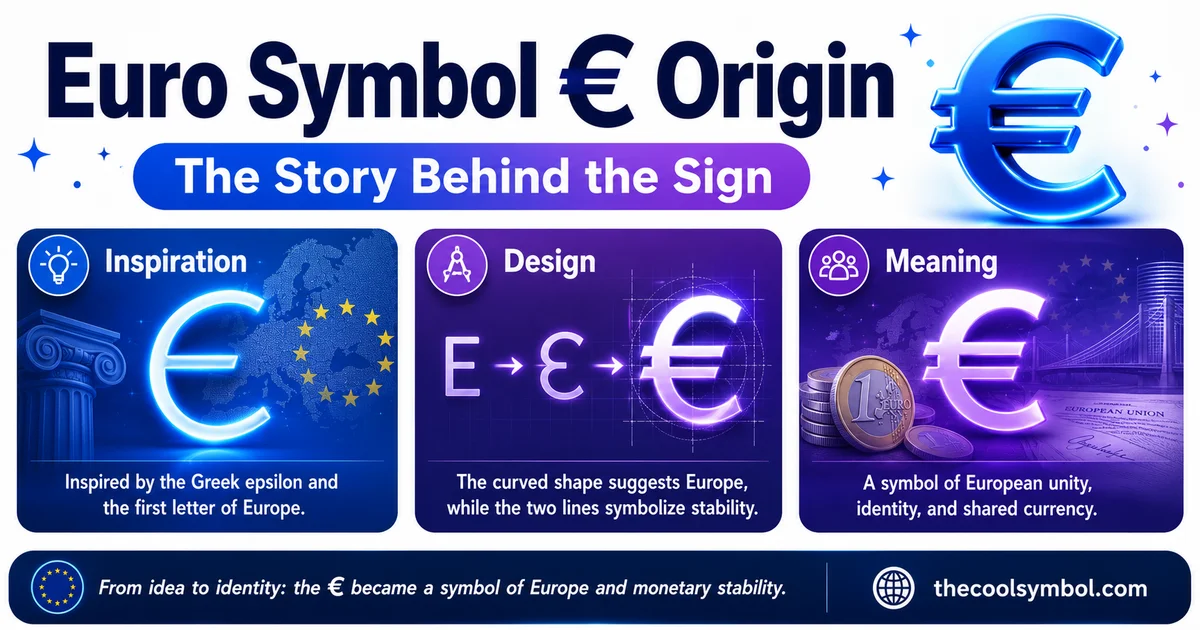
The main shape of the euro symbol is based on the Greek letter epsilon, which looks like a rounded E. There are two reasons for this choice.
First, it points back to ancient Greece. Greece is often called the birthplace of European culture, so using a Greek letter was a way to honor that history. Second, the letter E is also the first letter of the word “Europe.” So the shape does two jobs at once: it nods to Greece and it stands for Europe.
The two lines mean stability
Look closely and you’ll see two parallel lines running across the middle of the symbol. These lines were added on purpose. They are meant to stand for stability, the idea that the euro is a strong, safe and steady currency.
Two lines through a letter is also a common look for money symbols. You see something similar in other currency signs. The lines quietly say “this is money” while also carrying that message of strength.
The euro symbol, part by part
Here’s the whole symbol broken into its pieces, so you can see what each part is for.
So the euro symbol is really three simple ideas joined together: a link to Greece, the word Europe and a promise of stability. All in one small mark.
How the design was chosen
The euro symbol was not drawn by one person in an afternoon. It went through a careful process, almost like a contest.
The European Commission started with around 30 different designs. A team looked at all of them and picked the 10 best. Those 10 were then shown to the public across Europe, where people gave their feedback on which they liked most.
After the public gave their views, two top designs were left. The final pick was made by two important officials: Jacques Santer, the president of the European Commission at the time, plus Yves-Thibault de Silguy, the man in charge of the euro. They chose the winner, then showed it to the world in December 1996.
The symbol had to pass three tests. It needed to be simple to draw by hand, easy to recognize and it had to look like a proper money symbol. You can read the official meaning straight from the source on the European Union’s own euro design page, which confirms the epsilon and the stability lines.
Want to copy the euro symbol or browse other currency and symbol designs? Explore the full symbol collection here →. Every currency sign, from € to $, £ and ₹, ready to copy and paste anywhere you type.
The mystery: who really designed it?
Here’s the strangest part of the story. Even today, nobody knows for sure who actually designed the euro symbol.
The European Commission has said the symbol was made by a team of four people. But it has never shared their names. The Commission treats the whole design process as private, so the other designs and the designers are kept secret.
Because of this secrecy, more than one person has claimed to be the real creator. Two names come up most often.
Alain Billiet
A Belgian graphic designer named Alain Billiet is often credited as the person who made the final design that the Commission picked. Many reports point to him as the most likely creator.
Arthur Eisenmenger
A German designer named Arthur Eisenmenger also claimed he made the symbol years earlier. He said he created it while working as a designer for an early European group, claiming he had also designed the European flag. He felt he never got credit for it.
Since the Commission keeps the records secret, we may never know the full truth. It’s a rare case where one of the most-used symbols in the world has a creator nobody can fully confirm.
How the euro symbol is used
The way you write the euro symbol changes depending on where you are. This surprises a lot of people.
In English-speaking countries, the symbol goes before the number, like €10. But in many European countries, it goes after the number, like 10 €. Both are correct. It just follows the local habit of each language.
There’s also a short code for the euro: EUR. You see this used in banks, exchange rates and money transfers, especially when the actual symbol is hard to type. So €10 and EUR 10 mean the same thing.
The euro is the official money of 20 countries in Europe, plus a few small places outside the European Union. That’s a huge number of people using the same symbol every single day.
What the euro teaches about symbols
The euro symbol is special because it shows the opposite of how most symbols are born.
Most symbols grow slowly and by accident. The dollar sign, for example, came from a rushed handwriting shortcut that people repeated until it turned into a fixed shape. Nobody planned it. It just happened over time.
The euro is the reverse. It was planned first, then given to the world. One was an accident that stuck. The other was a decision made on purpose. Both ended up as symbols people use every day, but they got there in totally different ways.
It’s a bit like the difference between symbols that just point somewhere and symbols that carry a deeper message. A curved arrow simply shows an action like going back or repeating, while the euro packs history, culture and a whole political idea into one small mark.
And just like how a small change from a single to a double line changes an arrow’s meaning, the two little lines in the euro symbol carry their own big idea: stability. Tiny design choices can hold a lot of meaning.
3 things people get wrong about the euro symbol
1. That it’s an old symbol
The euro symbol feels like it has always been around, but it’s actually very new. It was only shown to the public in 1996, while the money arrived even later. It’s younger than many of the people using it.
2. That the E just stands for Europe
The E does stand for Europe, but that’s only half the story. The shape is really the Greek letter epsilon, chosen to honor ancient Greece as the home of European culture. It carries both meanings at once.
3. That the lines are just decoration
The two lines are not there just to look nice. They were added on purpose to stand for stability, a strong and steady currency. Every part of the symbol has a reason behind it.
Wrapping up
The euro symbol is one of the only money signs in the world with a real birthday. It was designed on purpose, shown to the public on 12 December 1996 and built to carry meaning in every part. The round shape comes from the Greek letter epsilon and stands for Europe. The two lines stand for stability.
It was picked from around 30 designs, narrowed down with public feedback and chosen by two top officials. And in a funny twist, the person who truly designed it is still not fully known, because the records were kept secret.
Next time you see a euro symbol, remember it’s not an old accident like most money signs. It’s a modern symbol, planned with care, with a story built right into its shape.