
Double Arrow ⇒ vs Single Arrow →: Mathematical and Logical Meanings
By The Cool Symbol Team on 2026-06-28
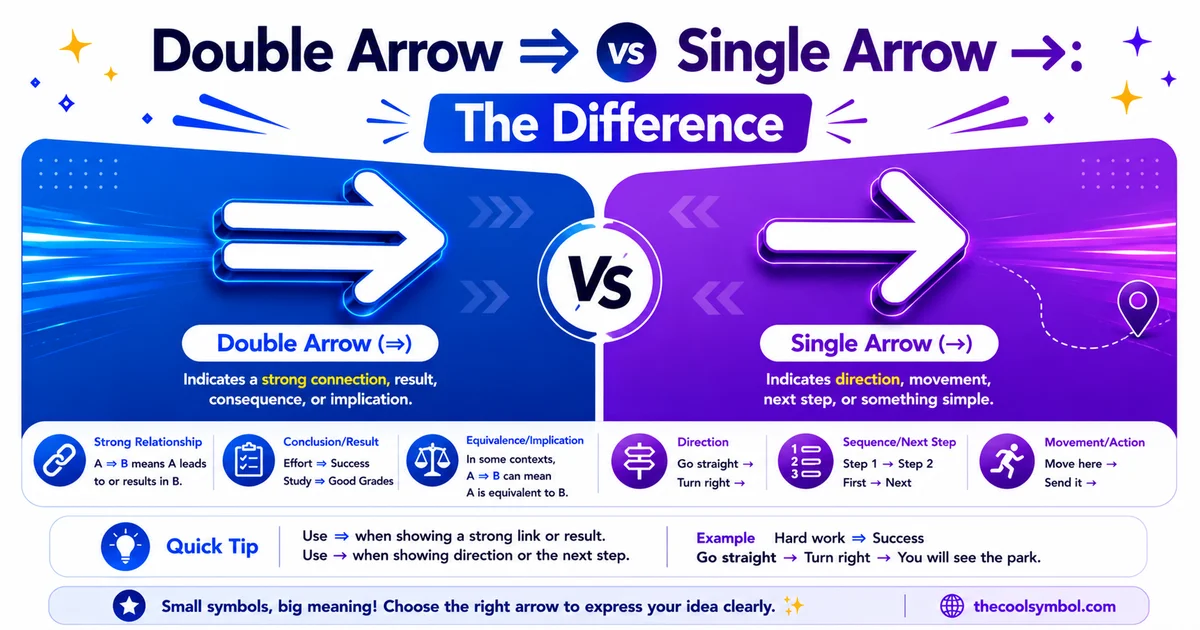
They look almost the same. One line versus two. But in math and logic, a single arrow and a double arrow can mean completely different things, so mixing them up can turn a correct statement into a false one.
If you’ve ever stared at a proof wondering why one line uses → and the next uses ⇒, you’re not alone. The distinction trips up students constantly, partly because the rules shift a little depending on the field and the writer.
The short version: a single arrow usually means “maps to” or “if-then,” while a double arrow usually means “implies” or “therefore.” But there’s real nuance underneath that. Knowing it will make every proof and logic statement you read clearer.
This guide breaks down exactly what the single arrow and double arrow mean in math and logic, when to use each, how the bidirectional versions work and why even mathematicians don’t always agree on the rules.
The quick answer
Here’s the core distinction in the most common convention.
- Single arrow (→): “maps to” in function notation, or “if-then” as a conditional connective inside a statement
- Double arrow (⇒): “implies” or “therefore,” asserting that one statement logically follows from another
- Single bidirectional (↔): a two-way conditional, often read “if and only if” in some texts
- Double bidirectional (⇔): logical equivalence, “if and only if,” the statements imply each other
The pattern to remember: double arrows carry more logical force. A single arrow connects ideas or maps values. A double arrow asserts that one thing genuinely proves or forces another.
The single arrow (→): what it means
The single right arrow has two main jobs in math, with the right one depending on context.
Job 1: Function and mapping notation
In this role, the single arrow describes a function. When you write f: A → B, you’re saying the function f takes inputs from set A and produces outputs in set B. The arrow means “goes to” or “maps to.”
A related arrow, the maps-to arrow (↦) with a small bar on its tail, shows what happens to a specific element. Writing x ↦ x squared says “x maps to x squared.” In most fields of mathematics, the plain single arrow is reserved for this function and mapping work, which is an important reason the double arrow exists for logic.
Job 2: The conditional connective
In formal logic, the single arrow is often used as the material conditional, the “if-then” connective. Writing P → Q means “if P, then Q.” This is a statement that can itself be true or false, with a defined truth table: it’s false only when P is true and Q is false.
Here the single arrow links two propositions into a single new compound proposition. It’s part of the statement, not a claim about the statement.
Approaching a limit is a third, narrower use: in calculus, x → 0 means “x approaches 0.” Same arrow, but read as movement toward a value rather than mapping or implication.
The double arrow (⇒): what it means
The double right arrow carries more weight. Its job is logical implication, working at a higher level than the single arrow’s conditional.
When you write P ⇒ Q, you’re asserting that P implies Q: that the truth of P logically forces the truth of Q. This is a claim being made about the relationship between the two statements, not just a compound statement sitting there to be evaluated.
This is why the double arrow appears in proofs. Each step says “this previous fact implies this next fact.” When a mathematician writes “n is even ⇒ n squared is even,” they’re asserting that being even genuinely forces the square to be even. The double arrow is the engine that drives a proof forward.
The subtle distinction
Some logicians draw the line this way: the single arrow conditional is the contemplated relation, the thing you’re examining, while the double arrow implication is the asserted relation, the claim you’re making. One sets up a statement to test. The other declares that the link holds.
In plain terms: P → Q is a sentence that might be true or false. P ⇒ Q is you saying, with authority, that P really does lead to Q.
Single vs double arrow at a glance
Here’s the full comparison, including the bidirectional versions, in one place.
Read it top to bottom and the logic is clear: single arrows do the connecting and mapping work, double arrows make the strong claims, while the bidirectional versions add the “both ways” meaning.
Need to copy any of these arrow symbols for your notes, proofs or documents? Explore the full arrow and symbol collection here →. Every arrow, from single → to double ⇒ and bidirectional ⇔, ready to copy and paste anywhere you type.
The bidirectional arrows (↔ and ⇔)
Both arrows have two-way versions, with the single-versus-double pattern holding for them too.
Single bidirectional (↔)
This is the biconditional connective. P ↔ Q joins two propositions into one compound statement meaning “P if and only if Q.” Like the single conditional, it’s a statement that can be evaluated as true or false. It’s true when P and Q have the same truth value, both true or both false.
Double bidirectional (⇔)
This asserts logical equivalence. P ⇔ Q claims that P and Q always have the same truth value, that each one implies the other. It’s the two-way version of the double arrow’s implication, used to assert that two statements are logically interchangeable.
The phrase “if and only if” (often shortened to “iff” in math writing) is the spoken form of these arrows. When you see it in a definition or theorem, a bidirectional arrow is the symbol behind it.
Why even mathematicians don’t fully agree
If this all feels slightly slippery, that’s because it genuinely is. The single-versus-double distinction is a convention, not a universal law, so conventions vary.
As Wikipedia’s list of logic symbols notes, not all writers observe the distinction in every context. Especially in mathematics, where the single arrow is reserved for function notation, it’s common to see the double arrow used for both the conditional and the implication, since the single arrow is already busy with functions.
So in a logic textbook, you might see a careful split: single arrow for the conditional, double arrow for implication. In a general math paper, you might see the single arrow doing only function work while the double arrow covers all of the if-then and implies duties. Both are valid within their own conventions.
The practical lesson: read the context and, if you’re writing, pick one convention and stay consistent. Consistency matters more than which exact rule you follow, as long as your reader can tell what each arrow means.
Seeing them in action
A few plain-language examples make the difference concrete.
Function (single arrow)
“f: ℝ → ℝ” reads as “f is a function from the real numbers to the real numbers.” The arrow shows the direction of the mapping, from inputs to outputs. No implication is being claimed here.
Implication (double arrow)
“x = 2 ⇒ x squared = 4” reads as “x equals 2 implies x squared equals 4.” Here you’re asserting that the first fact forces the second. This is the logic of a proof step.
Equivalence (double bidirectional)
“A triangle is equilateral ⇔ all three angles are equal” reads as “a triangle is equilateral if and only if all three angles are equal.” Each condition guarantees the other, so they’re logically equivalent.
These arrows beyond math
The single and double arrow distinction leaks into everyday technical writing too. In documentation, a single arrow often shows a sequence (“click File → Save”), while a double arrow sometimes signals a stronger “results in” or “leads directly to.”
Programmers see arrows constantly: many languages use a single arrow for function return types or lambda expressions, keeping that same “maps to” feeling from math. The logic of the symbol carries across from the proof to the code editor.
Even in casual writing, people borrow the implication feel of the arrow when they jot “more sleep ⇒ better focus.” They’re using the double arrow exactly as a mathematician would: to say one thing leads to another.
How these arrows compare to other symbols
Arrows belong to the functional family of symbols, the ones that do a precise job rather than carry feeling. That precision is what sets them apart from more expressive symbols.
Where a five-pointed star carries layered cultural meaning that shifts with context, a logic arrow means one exact thing in its notation. There’s no ambiguity once you know the convention, which is exactly what math demands.
And where the sparkles emoji adds tone and emphasis, or the shooting star carries wishes and wonder, logic arrows strip all emotion away. Their whole purpose is to state relationships with total precision, the opposite of an expressive symbol’s job.
3 common mistakes with single and double arrows
1. Using → when you mean ⇒ in a proof
In a proof, you usually want the double arrow to assert that one step implies the next. Using the single arrow can read as function notation or a mere conditional, which muddles the logic. When you mean “therefore,” reach for the double arrow.
2. Treating the arrows as interchangeable
They carry different logical weight. Swapping them freely can change a statement’s meaning, turning a claim about implication into a statement about a function or a simple conditional. Match the arrow to the meaning you intend.
3. Mixing conventions in one document
Because the rules vary by field, the worst thing you can do is switch conventions partway through. Pick one usage at the start, whether that’s the strict logic split or the function-only single arrow, then hold to it so your reader is never guessing.
Wrapping up
The single arrow and double arrow look nearly identical, but they carry different logical force. The single arrow maps and connects: functions, the if-then conditional, approaching a limit. The double arrow asserts: it says one statement implies, forces or proves another. Their bidirectional versions add the “both ways” meaning of equivalence.
The distinction is a convention, not an iron law, so it shifts a little between logic and general math. Read the context, then when you write, pick one convention and stay consistent. Get that right and your arrows will say exactly what you mean.
More lines, more force. That single idea unlocks most of what these arrows are telling you.