
British Pound £ Symbol: Origin, History and Why It Looks Like an L
By The Cool Symbol Team on 2026-07-21
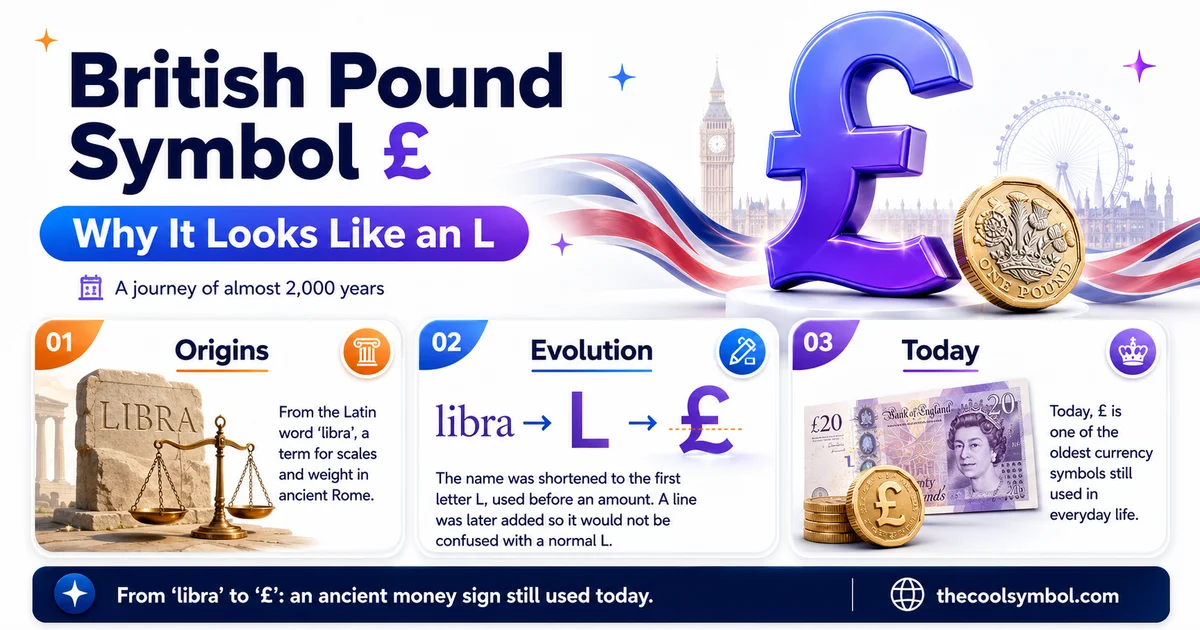
Look at the pound symbol: £. It’s really just a fancy letter L with a line through it. But the word “pound” doesn’t even start with an L. So why does the symbol look this way?
The answer takes us all the way back to ancient Rome. The £ sign is one of the oldest money symbols still used today. It has a story that is almost 2,000 years old.
And here’s the fun part. The L doesn’t stand for “pound” at all. It stands for a Latin word most people have never heard of. Once you know that word, the whole symbol makes sense.
In this guide you’ll learn where the £ symbol came from, why it looks like an L, why it has a line through it and why you sometimes see one line and sometimes two. It’s a short, interesting story, told in easy words.
The short answer
The £ symbol comes from the letter L. And the L stands for the Latin word “libra.”
In ancient Rome, “libra” meant scales or balance, the kind you use to weigh things. The Romans used a unit called “libra pondo,” which meant “a pound by weight.”
Over time, that phrase split into two things we still use. The word “pondo” gave us the English word “pound.” And the word “libra” gave us the letter L, which became the £ symbol. So the sound “pound” and the shape “£” come from two different halves of the same old Roman phrase.
That’s also why the short form for pounds in weight is “lb.” It comes from the very same word, libra. Pretty neat for a word most people have never said out loud.
From ancient Rome to British money
So how did a Roman weight word end up on British money? It happened slowly, over hundreds of years.
Long ago, money was often based on the weight of silver. In England, one pound of money was literally worth one pound weight of sterling silver. That’s where the name “pound sterling” comes from.
Because the money was measured by weight, people used the weight word for it: libra, shown as the letter L. Writers would put an L before an amount to mean “pounds.” As the years passed, that L got fancier and more decorative, until it slowly turned into the £ we know now.
This system is very old. It goes back to around the 7th and 8th centuries. That makes the pound one of the oldest currencies in the world that people still use every day.
Why does it have a line through it?
Here’s a good question. If the symbol is just the letter L, why does it have a line crossing through it?
The line was added for a simple, practical reason. In old account books and money records, a plain letter L could be confused with an ordinary L in a word. So people drew a line across it to show that this L meant money, not a normal letter.
It’s a small mark with a big job. That line turns a plain letter into a clear money symbol. The same idea shows up in other currency signs too. A line or two across a letter is a common way to say “this is money.”
You can see this exact trick in other symbols. The dollar sign also has a line through it, and that line has its own story from a different old coin. The line across a letter is a pattern you’ll spot again and again in money symbols.
How the £ symbol grew, step by step
The easiest way to see it is as a simple journey, from a Roman word to the sign on your money today.
Seen this way, the £ is not strange at all. It’s just the letter L, dressed up over many centuries, still doing the same job it did in Roman times.
Want to copy the pound symbol or find other currency and symbol signs? See the full symbol collection here →. Every money sign, from £ to $, € and ₹, ready to copy and paste anywhere you type.
One line or two? Both are correct
Look closely and you’ll notice the £ sometimes has one line across it and sometimes two. You might wonder which one is right. The answer is that both are fine.
For a long time, people drew the pound sign with either one bar or two, just based on style and the typeface. Neither was wrong. It was a bit like how some people cross their number 7 and some don’t.
But there’s an official answer for British money. According to the Bank of England’s own records, the Bank has used the single-bar £ on its banknotes since 1975. So if you want the “correct” British look, one line is the modern standard.
The Bank of England also says the exact date the line was first added to the L is not known for sure. But there’s a cheque from the year 1660 that already shows a clear £ sign. So the symbol is at least that old, maybe older.
The old British money system
Here’s a bit of history that surprises people. For a very long time, British money was not counted in a simple way like it is now.
Before 1971, one pound was split into 20 shillings. Each shilling was split into 12 pence. That meant there were 240 pence in a pound. Doing math with money back then was much harder than today.
This old system used three short letters: £ for pounds, “s” for shillings and “d” for pence. All three came from Latin words. The £ came from libra, the “s” from solidus and the “d” from denarius. So the whole system was built on old Roman words.
In 1971, Britain made money simpler. They switched to a system where one pound is just 100 pence. Much easier. But the £ symbol stayed exactly the same, carrying its long history forward.
How the pound symbol is used
The £ symbol is used for the British pound, the money of the United Kingdom. It goes before the number, like £50. You would not write 50£.
There’s also a short code, GBP, which stands for Great Britain Pound. Banks and money exchanges use GBP, mostly when they deal with other countries. So £50 and GBP 50 mean the same thing.
One common mix-up is worth clearing up. The £ is the pound, not the euro. The euro uses the € symbol. The United Kingdom has always kept its own pound and its own £ sign, even in the years it was part of the European Union.
If you’re curious how the euro’s symbol came to be so different, the euro symbol has its own interesting story, and it was made in a completely different way from the pound. One grew slowly over centuries. The other was designed on purpose in modern times.
What the pound symbol shows us
The pound symbol is a great example of how the oldest symbols are born. Nobody sat down and designed the £. It grew on its own, slowly, over a very long time.
It started as a full Latin word. Then it became a single letter. Then a line was added to make it clear. Each small change happened for a real reason, so the result is a symbol that feels simple but holds centuries of history.
This is the opposite of some newer symbols. The Indian rupee symbol was designed on purpose in 2010, chosen from a big contest in just a couple of years. The pound took almost 2,000 years to reach its shape. Both are money symbols, but they were born in totally different ways.
3 things people get wrong about the £ symbol
1. That the L stands for “pound”
The L does not stand for “pound.” It stands for the Latin word “libra,” which meant weight and scales. The word “pound” actually comes from the other half of the phrase, “pondo.”
2. That two lines is wrong
Some people think the £ must have one line. But both one line and two lines have been used for a long time, so both are correct. The Bank of England just picked one line as its standard for banknotes in 1975.
3. That it’s the same as the euro
The £ is the British pound. The € is the euro. They are two different currencies with two different symbols. The UK uses the pound, not the euro.
Wrapping up
The pound symbol looks like an L because it started as one. The L stands for the Latin word “libra,” meaning weight and scales, from the Roman phrase “libra pondo.” That same phrase gave us the word “pound.” The line through the L was added so it wouldn’t be confused with a normal letter.
You can write it with one bar or two, but the Bank of England has used a single bar since 1975. The symbol is nearly 2,000 years old, which makes it one of the oldest money signs still used every day.
So the next time you see a £, remember you’re looking at a Roman weighing word, shortened to a letter, crossed with a line and passed down through almost 2,000 years of history. Not bad for a simple little L.