
What Is the Bullet Point • Symbol? History and Modern Use Cases
By The Cool Symbol Team on 2026-08-28
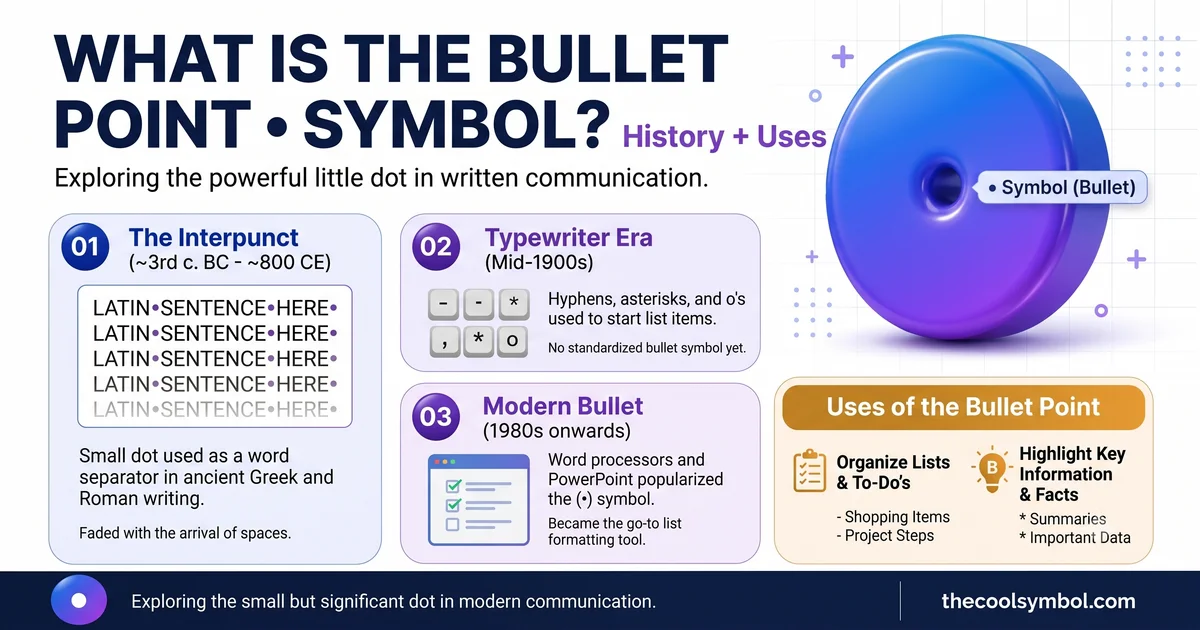
You use it every day. In documents, in presentations, in your resume, in your Instagram bio. The little dot that starts a list item: •. It’s so common that you’ve probably never stopped to think about where it came from.
The bullet point is one of the most used symbols in the world, but it’s also one of the newest. Unlike many symbols that are hundreds or thousands of years old, the bullet as a list marker only became standard in the middle of the 1900s.
But here’s the interesting part. The dot itself is much older. A smaller version of it was used by the ancient Romans, not for lists, but for something completely different: putting spaces between words.
In this guide you’ll learn what the bullet point really is, where it came from, its ancient ancestor and all the clever ways people use it today. Easy words, fun story.
What is the bullet point?
A bullet point is a small dot or shape used to mark items in a list. That’s its whole job: to make each point easy to spot. As Wikipedia’s article on the bullet symbol notes, the standard form is a small filled circle, centered on the line of text.
The name “bullet” comes from old French words: “boulette” meaning “small ball” and “boulet” meaning a round shot. The dot does look like a tiny ball, so the name fits.
In Unicode, the system that gives every symbol a code so computers can show it, the bullet point is character U+2022. It’s found in the General Punctuation block, right alongside other everyday marks.
Here’s one thing that surprises people. The bullet point is technically not a punctuation mark. It’s a typographic symbol, a visual helper used to organize text. A period ends a sentence. A comma makes a pause. A bullet point starts a list item. It’s about layout, not grammar.
The ancient ancestor: the interpunct
The bullet point has an older cousin called the interpunct. It looks like a smaller, lighter dot placed in the middle of the line: ·. And it’s very, very old.
In ancient Rome, people wrote without spaces between words. A sentence looked like one long run of letters, which we now call “scriptio continua.” Reading it was hard, so the Romans started placing a small dot between words to mark where one ended and the next began.
That dot was the interpunct. Scholars in Alexandria, the great ancient Greek city of learning, had created it as part of the very first punctuation system around the 3rd century BC. So the idea of using a dot to make text clearer goes back over 2,000 years.
Over time, spaces replaced the interpunct for separating words. By around 600 to 800 CE, most writing used white space instead of dots. The interpunct mostly faded away.
But it never fully disappeared. You can still find it today in Catalan (a language spoken in parts of Spain), in dictionaries to show where syllables break (like “bul·let”) and in some math uses. The dot survived by finding new jobs.
How the modern bullet point was born
The bullet point as we know it, the list marker, is a product of the 20th century. Its rise happened in two big steps.
Step 1: The typewriter age
In the typewriter era, people started using simple marks like hyphens (-), asterisks (*) and lowercase o’s to start list items. There was no special bullet key on a typewriter, so people used whatever was handy. The idea of marking each point in a list was growing, but there was no standard way to do it.
Step 2: The word processor revolution
Everything changed when computers arrived. Word processors like Microsoft Word gave users a real bullet button. You could click it and get a clean, round dot at the start of each line. Suddenly, making a neat bullet list was easy for everyone.
Then came PowerPoint. Slide presentations put bullet points center stage. Entire talks were built around bulleted lists. By the 1990s, the bullet point was everywhere: in offices, schools, reports and handouts. It became the default way to present a list of ideas.
So the modern bullet point is only about 40 to 50 years old as a standard. It was born from the need to organize information clearly on a screen and a printed page.
From ancient dot to modern bullet
Here’s the journey of the dot, from word separator to list maker, at a glance.
A 2,000-year journey from a tiny word separator to the most common formatting mark on the planet. The dot kept finding new jobs.
Want to copy the bullet point or browse other useful symbols? See the full symbol collection here →. Every symbol, from • to ★, → and more, ready to copy and paste anywhere you type.
Bullet points come in many shapes
The standard bullet is a filled black circle. But that’s just the default. There are many other shapes people use as bullets.
- Filled circle: • (the standard)
- Hollow circle: ○ (a lighter, softer look)
- Filled square: ▪ (common in technical writing)
- Arrow: ► or → (points toward the item, suggests action)
- Diamond: ◆ (a decorative choice)
- Dash: – (simple and clean)
Word processors let you pick from all of these. The shape you choose changes the feel of your list: circles feel soft, squares feel technical, arrows feel active. It’s a small design choice that makes a real difference.
How people use bullet points today
Bullets are everywhere in modern life. Here are the most common places you see them.
Documents and reports
This is the classic use. Any time you have a list of ideas, steps or items, bullet points make them easy to scan. Readers can find what they need without reading every word.
Presentations and slides
PowerPoint and Google Slides run on bullets. Short, punchy points on each slide help the audience follow along. The bullet became the backbone of business communication.
Resumes and CVs
Job seekers use bullets to list their skills and experience. A resume without bullet points would be a wall of text that nobody wants to read.
Social media bios
On Instagram, Twitter and other platforms, people use bullet dots to separate bits of info in their bios. Something like: designer • dog mom • coffee lover. It’s a quick, clean way to show who you are.
Websites and menus
Navigation menus, feature lists and pricing pages all lean on bullets to keep things organized. On the web, the HTML list uses bullets by default.
Bullet point vs interpunct: know the difference
Since both are dots, people sometimes mix them up. But they’re different characters with different jobs.
The bullet point (•) is bigger, bolder and used to mark list items. The interpunct (·) is smaller, lighter and used to separate words or syllables. In Unicode, they have different codes: the bullet is U+2022, the interpunct is U+00B7.
In most everyday use, this difference doesn’t matter much. But if you’re writing code, building a website or setting up a design, using the right character keeps things clean and correct.
What the bullet point shows us
The bullet point teaches a nice lesson about symbols. Not all of them come from deep history or clever design. Some are born simply because people needed a better way to organize information.
Compare it to a symbol like the square root mark, which was created by a specific person in a specific year. The bullet has no single inventor. It grew out of a shared habit, millions of people all agreeing that a dot before a line is a good idea.
Other symbols do very precise work. The sigma symbol adds up numbers in math, while the degree symbol counts steps on a temperature or angle scale. The bullet does something simpler but just as useful: it tells your eye where each new point begins.
Simple doesn’t mean unimportant. The bullet point may be the most-used formatting symbol in the world. That makes it one of the most useful symbols ever, even if it’s just a dot.
3 things people get wrong about bullet points
1. That the bullet is ancient
The dot is ancient (the interpunct goes back over 2,000 years). But the bullet point as a list marker is modern, becoming standard only in the second half of the 1900s with computers.
2. That bullets must be round
The round dot is just the default. Bullets can be squares, diamonds, arrows, dashes or any shape. The form changes the feel, but they all do the same job.
3. That bullets are a type of punctuation
Technically, the bullet point is a typographic symbol, not a punctuation mark. It organizes text visually, but it doesn’t mark grammar the way a comma or a period does.
Wrapping up
The bullet point • is a tiny dot with a big job: marking items in a list so they’re easy to read. Its ancestor, the interpunct, was used by the ancient Greeks and Romans to separate words more than 2,000 years ago. The modern bullet came much later, becoming standard with word processors and PowerPoint in the late 1900s.
Today you find it everywhere: in documents, slides, resumes, bios and websites. It comes in many shapes beyond the classic circle. It’s technically not punctuation but a typographic helper, one of the most used formatting symbols in the world.
So the next time you tap that bullet button, remember you’re using a symbol with a very old family tree. A tiny dot that went from separating Roman words to organizing your entire modern life.