
Sigma Σ Symbol: What It Means in Math, Statistics, and Internet Culture
By The Cool Symbol Team on 2026-08-15
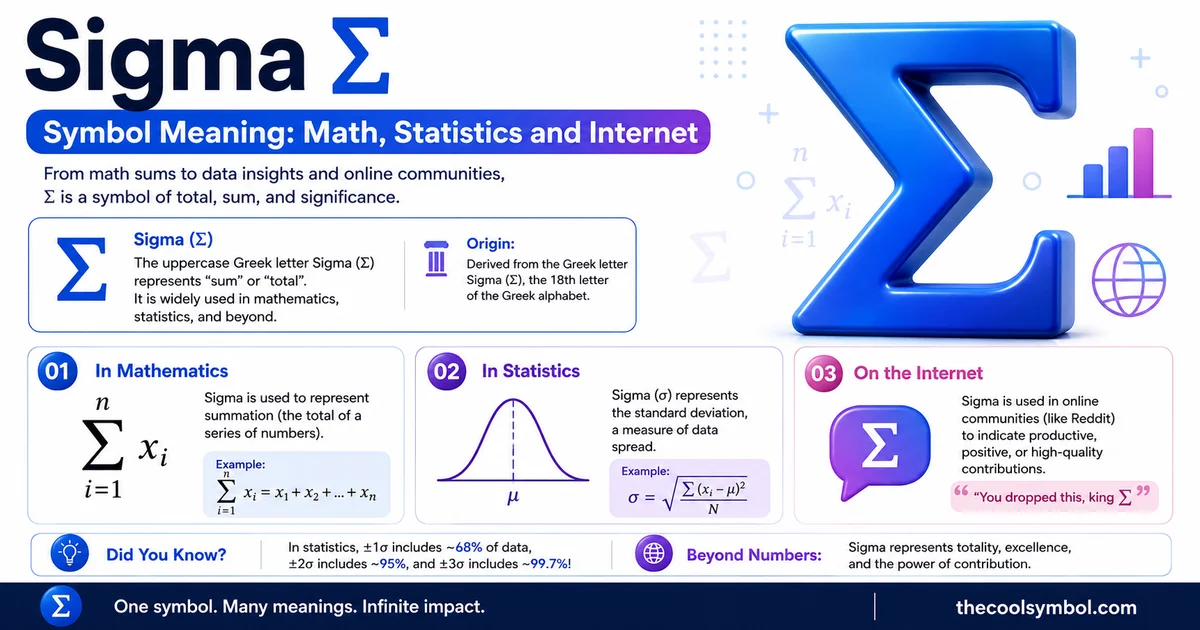
If you’re a student, sigma means “add it all up.” If you’re into statistics, it means “how spread out are the numbers.” If you’re on TikTok, it means something completely different.
The word sigma has taken over the internet. But long before the memes, it was one of the most important letters in all of math and science. It’s been in use for thousands of years, yet it still shows up in almost every math class.
What makes sigma special is that it does different jobs depending on whether you write it big (Σ) or small (σ). The big version means one thing. The small version means something else. And the internet version has nothing to do with either.
In this guide you’ll learn what the sigma symbol really means in math, statistics and online culture. Three very different worlds, one Greek letter. Easy words, fun story.
What is sigma?
Sigma is the 18th letter of the Greek alphabet. As Wikipedia’s sigma page explains, it matches the English letter S. It has been part of the Greek language for thousands of years.
The letter comes in three shapes. There’s the big uppercase version (Σ), the small lowercase version (σ), plus a special version used only at the end of Greek words (ς). Each one has its own job.
In Greek, sigma is just a normal letter, like S is for us. But in the world of math and science, it became something much bigger. Scientists borrowed it centuries ago because they needed more symbols than the English alphabet could give them.
Big sigma Σ: adding things up
The uppercase sigma (Σ) is one of the most used symbols in math. Its job is simple: it means “add all of these numbers together.”
Let’s say you want to add the numbers 1 through 5. You could write 1 + 2 + 3 + 4 + 5 = 15. But in math, there’s a shorter way. You write Σ with small numbers that say where to start and where to stop. That little sign tells the reader to add up the whole list.
This is called summation notation, which just means “a short way to write addition.” The Swiss mathematician Leonhard Euler started using it around 1755. He needed a fast way to write long sums, so he picked the Greek letter S (for “sum”).
Euler also helped make another Greek letter famous: pi (π), which he made the standard symbol for the circle number 3.14. So this one man gave us two of the most used math symbols in the world.
You’ll see Σ everywhere: in algebra, calculus, statistics and even computer science. Any time a formula needs to say “add a whole bunch of numbers,” sigma is the shortcut.
Small sigma σ: how spread out are the numbers?
The lowercase sigma (σ) has a completely different job. In statistics, it stands for standard deviation, which is a measure of how spread out a set of numbers is.
Here’s a simple example. Say you have two groups of test scores. Group A scores are 70, 71, 69, 72. Group B scores are 40, 95, 60, 100. Both groups have the same average. But Group B’s numbers are way more spread out. Group B has a higher σ.
So when you see a low σ, the numbers are close together and steady. When you see a high σ, the numbers are all over the place. That’s really all standard deviation means: how much do the numbers jump around?
Six Sigma in business
You may have heard of “Six Sigma” in the business world. It’s a method for making things with very few mistakes. The name comes from the idea that if your process is six standard deviations away from an error, it’s almost perfect, only 3.4 mistakes per million. Big companies like Motorola and Toyota made it famous.
One letter, three worlds
Here’s the whole thing at a glance: the same letter doing three very different jobs.
Context is everything. The exact same word means "add it up" in math class, "how spread out" in statistics and "cool lone wolf" on TikTok. One letter, three completely different worlds.Want to copy the sigma symbol or browse other math and fun symbols? See the full symbol collection here →. Every symbol, from Σ to π, ∞, ° and more, ready to copy and paste anywhere you type.
Sigma on the internet: the “sigma male”
Now for the meaning that blew up online. If you’ve been on TikTok, YouTube or Reddit in the last few years, you’ve probably seen “sigma” used as slang.
The “sigma male” idea describes a person (usually a man) who is independent, quiet and successful without needing to lead or follow anyone. Unlike an “alpha” who leads the group, the sigma stays outside the group entirely and still does well. Think of a calm, self-reliant lone wolf.
The concept started around 2010 in a blog post that split men into types: alpha, beta and sigma. The sigma was described as someone who wins without playing the social game. Over time, the term jumped from blogs to memes to TikTok edits, where phrases like “what the sigma” became viral jokes.
Here’s the honest part: this idea has no real basis in science. There is no psychology research that proves sigma is a real personality type. It’s an internet label, used sometimes seriously and sometimes as a joke. Merriam-Webster has added it as internet slang, but no science textbook has.
Sigma in science
Beyond math and the internet, sigma shows up in science too.
In physics, σ is used for things like stress on materials and electrical conductivity
In chemistry, a “sigma bond” is the strongest type of bond between two atoms
These uses are technical, but they show how busy this one Greek letter is. It’s working in math, statistics, physics, chemistry and the internet all at once.
What sigma shows us about symbols
Sigma is a perfect example of a symbol that means different things in different places. The same shape carries totally different ideas depending on the context.
Other math symbols do one job. The infinity symbol always means “no end”, and the degree symbol always counts steps on a scale. Sigma is unusual because it does several very different jobs. Big version, small version and internet version are almost like three separate symbols sharing one name.
That’s also what makes it confusing for people who hear it for the first time. A student searching “what does sigma mean” might be doing homework, looking up stats or trying to understand a meme. Context is the key.
3 things people mix up about sigma
1. That big sigma and small sigma mean the same thing
They don’t. Big Σ means “add it up” (summation). Small σ means “how spread out” (standard deviation). The size of the letter changes the meaning completely.
2. That the sigma male is a real science idea
It’s not. The “sigma male” is an internet meme, not a proven personality type. No real psychology research supports it. It can be fun, but it shouldn’t be taken as science.
3. That sigma is rare or unusual
Sigma is one of the most used symbols in math and science. You’ll find it in almost every math textbook, every statistics class and every science paper. It’s not rare at all, it’s everywhere.
Wrapping up
Sigma (Σ, σ) is the 18th letter of the Greek alphabet, matching the English S. In math, the big Σ means “add it all up.” In statistics, the small σ means “how spread out are the numbers.” On the internet, sigma means an independent, self-reliant person, though this has no basis in science.
One Greek letter, three very different meanings. The math uses have been around for centuries (summation since Euler in 1755). The internet use is brand new (starting around 2010). Both are part of how people use the word sigma today.
So the next time you see sigma, just check the context. In a textbook, it’s math. In a statistics report, it’s data. On TikTok, it’s a meme. Same letter, different worlds.