
Square Root √ Symbol: Origin and Why Mathematicians Chose This Shape
By The Cool Symbol Team on 2026-08-15
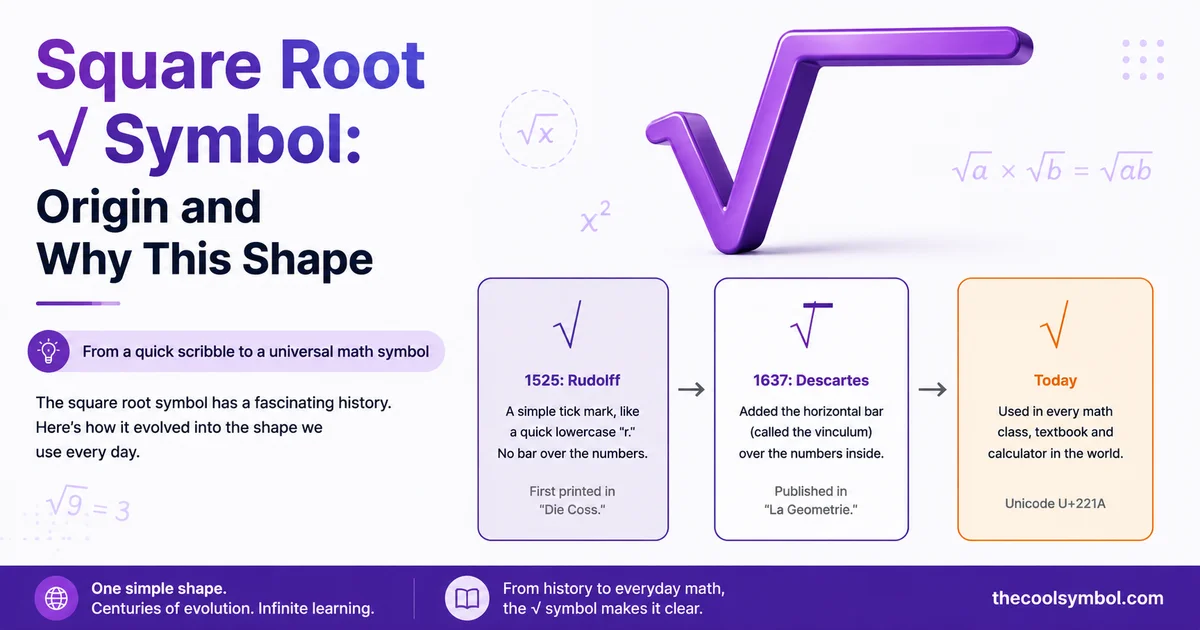
The square root symbol looks strange. It’s not a letter. It’s not a number. It’s a tick mark with a long arm stretched over the numbers it covers. Where did this odd little shape come from?
The answer starts with a German math teacher in the year 1525 and a Latin word that means “root.” The symbol has changed a few times since then, with a French mathematician adding the finishing touch more than 100 years later.
What makes this story fun is that nobody is 100% certain why the shape looks the way it does. There are a few good guesses, but the man who created it never wrote down his reason. So there’s a small mystery at the heart of one of math’s most used symbols.
In this guide you’ll learn what the square root symbol means, who first used it, the two best theories for its shape and how it became the mark we all know today. Easy words, short story.
What does the square root symbol mean?
Before the history, let’s make sure the math is clear. It’s simpler than it looks.
The square root of a number asks one question: what number, multiplied by itself, gives me this? That’s it.
For example, √9 = 3, because 3 times 3 = 9. And √25 = 5, because 5 times 5 = 25. You’re looking for the number that fits into itself to make the one under the symbol.
The word “square” comes from the fact that a square with sides of length 3 has an area of 9. So finding the square root is like working backwards from the area to the side length. That’s why it’s called a “root,” the starting point that grew into the bigger number.
Why it’s called a “radical”
In math, the square root symbol has an official name: the radical sign. This name comes from the Latin word “radix,” which simply means “root.”
The word radix is the same root behind the English words “radish” (a root vegetable) and “radical” (going to the root of something). So when math people say “radical,” they just mean “root.” Nothing wild or extreme about it.
This Latin connection is also the key to understanding why the symbol looks the way it does. The shape may come from the letter r, the first letter of “radix.” More on that in a moment.
The man who first used it
The square root symbol first appeared in print in the year 1525. A German mathematician named Christoph Rudolff put it in his algebra textbook called “Die Coss.”
Rudolff was born in 1499 in Jawor (now in Poland) and later studied at the University of Vienna. His book was the first algebra textbook written in German, which was a big deal at the time because most math was written in Latin.
As Wikipedia’s article on the radical symbol explains, Rudolff’s original mark looked like a small tick or checkmark, much simpler than what we use today. It had no horizontal bar over the numbers. That addition came later.
But Rudolff never explained why he picked this shape. He just used it and moved on. That’s why the exact reason for its look is still debated.
Why does it look like that? Two theories
Since Rudolff left no explanation, math historians have come up with two main ideas for the shape.
Theory 1: A stylized letter r
The most popular idea is that the shape started as a lowercase letter “r,” written quickly in a handwriting style. The r stands for “radix,” the Latin word for root. Over time, the quick handwritten r grew a tail and became the tick mark we now know as the radical sign.
The famous math historian Florian Cajori said it’s “possible, perhaps probable” that Rudolff’s mark was a quick r, though no one can fully prove it.
Theory 2: An Arabic letter
Another idea traces the symbol to Arabic mathematicians. A scholar named al-Qalasadi, who lived from 1421 to 1486, used the Arabic letter that starts the Arabic word for “root.” Some historians think this practice may have influenced the European version.
Both theories connect the symbol to the idea of a “root.” Whether it came from a Latin r or an Arabic letter, it was always about the same word: root. That much is clear.
How the √ symbol grew, step by step
The symbol didn’t arrive fully formed. It took two people, 112 years apart, to give us the shape we use today.
Rudolff gave us the checkmark. Descartes added the bar. Together, they made the symbol that every student learns today.Want to copy the square root symbol or browse other math and everyday symbols? See the full symbol collection here →. Every symbol, from √ to π, ∞, °, Σ and more, ready to copy and paste anywhere you type.
What the bar on top does
The horizontal line that stretches over the numbers is called the vinculum. It was added by the French mathematician Rene Descartes in 1637, in his famous book “La Geometrie.”
The vinculum has one simple job: it shows exactly which numbers are inside the root. Without the bar, it would be hard to tell where the square root starts and stops, especially in a long equation.
Think of it like an arm reaching over the numbers to hold them together. Everything under the bar is being rooted. Everything outside is not. It’s a small line that clears up a lot of confusion.
Where you see the square root in real life
The square root symbol shows up in many more places than just math homework.
The Pythagorean theorem: finding the length of one side of a right triangle uses a square root
The distance formula: finding the straight-line distance between two points on a map
Statistics: the standard deviation formula has a square root in it
Physics: speed, energy and wave calculations all use square roots
Building and engineering: sizing beams, wires and supports
Any time something grows or shrinks by squaring, the square root is how you undo it and find the starting number. It’s a basic building block that appears across all of science.
Beyond square roots
The same symbol is also used for cube roots and higher roots. The only difference is a small number tucked into the corner of the symbol.
A cube root (∛) asks: what number, multiplied by itself three times, gives me this? So ∛27 = 3, because 3 times 3 times 3 = 27. A fourth root (∜) asks the same thing with four multiplications.
The symbol stays the same tick-with-a-bar shape. Just the little number in the corner changes. This simple system lets one symbol handle roots of any size.
What the square root symbol shows us
The story of the square root symbol is a nice example of how math notation is built by many people over many years. One person starts a mark. Someone else improves it. And slowly it becomes the standard.
You see the same pattern with other math symbols. The pi symbol was first used by William Jones in 1706 and then made famous by Euler. It took two people to make pi standard, just like it took Rudolff and Descartes to build the square root symbol.
It’s also a reminder that many math symbols are just letters in disguise. The √ comes from the letter r. The degree symbol comes from the shape of a circle. The infinity symbol may come from an old number or a Greek letter. Once you know the letters and shapes behind the marks, the symbols feel much less mysterious.
3 things people get wrong about the √ symbol
1. That the shape is random
It’s not random. It most likely comes from the letter r, for the Latin word “radix” meaning root. The shape has a reason, even if it’s not fully proven.
2. That one person made the whole thing
The modern symbol was built by two people. Rudolff made the checkmark in 1525. Descartes added the bar in 1637. Both parts were needed to make the symbol we use today.
3. That it’s only for square roots
The same symbol handles cube roots, fourth roots and any other root. A small number in the corner tells you which type. One shape does many jobs.
Wrapping up
The square root symbol √ was first printed by Christoph Rudolff in 1525, probably as a quick lowercase r for the Latin word “radix” (root). It started as a simple tick mark with no bar. Then Rene Descartes added the horizontal bar in 1637, creating the shape we all recognize today.
Nobody knows for certain why it looks the way it does. The two main ideas are a Latin r and an Arabic letter, both pointing to the word “root.” Either way, the symbol has done the same job for 500 years: ask what number, times itself, gives you this one.
So the next time you see that little checkmark with its long arm reaching over the numbers, remember two math lovers, a century apart, each adding one piece to build a symbol the whole world still uses.