
Degree Symbol ° Meaning: From Temperature to Angles and Beyond
By The Cool Symbol Team on 2026-08-01
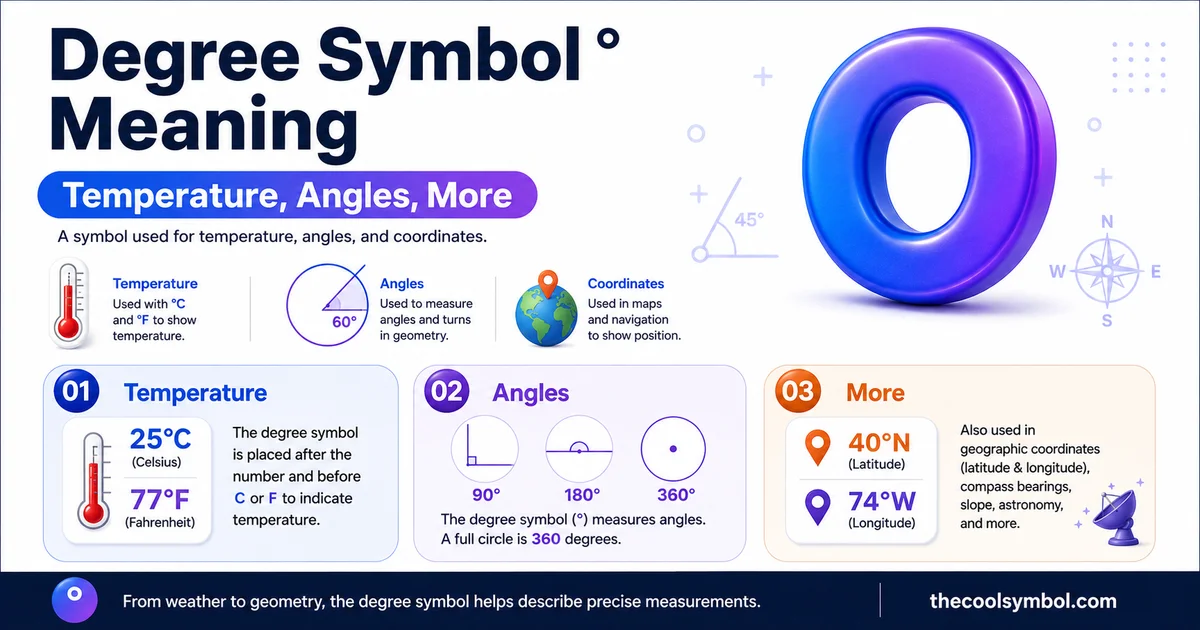
It’s one of the smallest symbols you use. Just a tiny circle in the air: °. You see it on weather apps, in math homework and on maps. But have you ever wondered what it really means or where it came from?
The degree symbol is much older than you’d think. It traces back to the ancient Babylonians, who split a circle into 360 parts thousands of years ago. That choice still shapes how we measure angles, temperature and locations today.
And the symbol itself is a small circle for a reason. It’s a tiny picture of the very thing it measures: a full circle. Once you know that, the shape clicks.
In this guide you’ll learn what the degree symbol means, where it came from, its three main jobs in the real world and how to type it on any device. Easy words, short story, one useful symbol.
What the degree symbol means
At its core, the degree symbol stands for one simple idea: a step of measurement.
The word “degree” comes from the Latin word “gradus,” which means “a step.” Each degree is one small step along a scale. A full circle has 360 of these steps. A right angle has 90. A fever might be 102°F. Each number counts the steps along whatever scale you’re using.
The little circle shape fits this idea well. It’s a tiny picture of a full circle, reminding you that the degree system started with circles. One full trip around a circle is 360°. So the symbol carries its own meaning in its shape.
Where the degree symbol came from
The idea of splitting a circle into 360 parts goes back about 4,000 years to ancient Babylon. The Babylonians used a number system based on 60, not 10 like we use today. Since 60 times 6 is 360, they divided the circle into 360 degrees. That number was handy because it can be split evenly in many ways.
As Wikipedia’s article on the degree angle explains, this Babylonian system was picked up by Greek astronomers and later by the whole world. It has stayed the standard for thousands of years.
The symbol itself, the small raised circle, started appearing in the 16th and 17th centuries. Scientists and star-watchers needed a quick mark to mean “degrees of arc” in their charts. The little circle was a natural choice, since it looks like the circle being measured.
Later, when thermometers were invented, the same symbol was borrowed for temperature. Daniel Fahrenheit created his scale in 1724. Anders Celsius created his in 1742. Both used the ° mark. So a symbol that began with circles in the sky ended up on weather apps in your pocket.
The three main jobs of the degree symbol
The degree symbol does three different things, depending on where you see it. All three come from the same core idea of counting steps on a scale.
Job 1: Measuring angles
This is the oldest use. A full circle is 360°. A right angle, like the corner of a book, is 90°. A straight line is 180°. Every time you see ° in math or geometry, it’s counting the turn or the angle.
Angles can also be broken into smaller pieces. One degree is split into 60 minutes (written with a single tick mark ′). One minute is split into 60 seconds (written with a double tick mark ″). This system also comes from the Babylonian base-60 idea.
Job 2: Measuring temperature
When you see 30°C on a weather app, the ° is counting steps on a temperature scale. Celsius and Fahrenheit are the two main scales, with both using the degree symbol.
A quick way to remember: water freezes at 0°C or 32°F, then boils at 100°C or 212°F. The symbol is the same for both scales. Only the letter after it (C or F) tells you which one.
Job 3: Marking locations on the Earth
GPS coordinates, maps and globes all use degrees. Your location on Earth is given in degrees of latitude (how far north or south you are) and longitude (how far east or west you are).
For example, the city of London is at about 51.5° N latitude. That ° symbol is doing the same job it does in geometry: counting steps along a curve, in this case the curve of the Earth.
One symbol, three jobs
Here’s the whole thing at a glance: one tiny circle doing three very different tasks.
All three are really the same idea: counting steps along a scale. The scale just changes depending on whether you’re measuring a turn, heat or a place on the planet.
Want to copy the degree symbol or browse other math and everyday symbols? See the full symbol collection here →. Every symbol, from ° to ∞, π and more, ready to copy and paste anywhere you type.
How to type the degree symbol on any device
Finding the ° on your keyboard can be tricky. Here are the quick ways for each device.
- Windows: hold the Alt key and type 0176 on the number pad, then let go of Alt
- Mac: press Option + Shift + 8
- iPhone: hold the zero (0) key on the keyboard, then ° appears as a choice
- Android: switch to the numbers and symbols keyboard, then look for ° near the other signs
- Copy and paste: the easiest way of all is to just copy ° from a symbols page and paste it wherever you need it
Once you know the trick for your device, it takes about one second. But when you’re in a rush, copy-paste from a symbols page is the fastest path.
Why a circle is 360 degrees
This is a question that surprises people. Why 360? Why not a nice round number like 100?
The answer goes back to the ancient Babylonians. They counted in groups of 60 instead of groups of 10. Their calendar had about 360 days in a year, so they linked one degree to one day of the sun’s path across the sky. Since the year has roughly 360 days, they split the circle into 360 parts.
The number 360 also has a practical trick: it divides evenly by many numbers, like 2, 3, 4, 5, 6, 8, 9, 10, 12 and more. That makes it very easy to split a circle into equal pieces. Try doing that with 100, because it doesn’t divide nearly as neatly.
So the whole reason we use 360° in a circle today is because of how Babylonians counted thousands of years ago. It’s a very old choice that turned out to be very useful.
One common mix-up to avoid
There’s a look-alike character that confuses people. The degree symbol (°) and the masculine ordinal indicator (º) look almost the same on screen, but they’re different things.
The ordinal indicator (º) is used in Spanish, Portuguese and Italian to write things like 1º (meaning “first”). It’s a language symbol, not a measurement one. The degree symbol (°) is the one for temperature, angles and locations.
On a keyboard or phone, you’ll usually pick the right one without thinking. But if you’re writing something technical or coding, make sure you use the real degree sign (Unicode U+00B0), not the ordinal one (Unicode U+00BA).
What the degree symbol shows us
The degree symbol is a nice example of how a practical mark can last for thousands of years if it does a useful job.
It’s similar to how the infinity symbol grew from a math mark into something used everywhere. Both are tiny shapes that carry a big, useful idea. One means “forever.” The other means “one step along a scale.” Small marks, lasting power.
And like the pound sign that came from Latin roots thousands of years ago, the degree symbol also traces back to an ancient civilization. Its Babylonian roots are still alive every time you check the weather or use a protractor.
Not every symbol has such old roots, though. The Indian rupee sign was designed just in 2010, showing that some symbols are very new while others, like the degree mark, have been around for ages. Both work just as well.
3 things people get wrong about the degree symbol
1. That it’s just for temperature
Temperature is the most common use, but the degree symbol also measures angles and locations on the Earth. It has three jobs, not one.
2. That 360 is a random number
It’s not random at all. It comes from the ancient Babylonian number system based on 60 and their calendar. It stuck because 360 divides so neatly into many equal pieces.
3. That the ordinal symbol is the same
The degree sign (°) and the ordinal indicator (º) look alike but are different characters with different jobs. Using the wrong one can cause problems in code or technical writing.
Wrapping up
The degree symbol ° is a tiny circle that counts steps along a scale. It measures angles (360° in a circle), temperature (30°C on a warm day) and places on the Earth (like 28.6° N for Delhi). All three jobs come from the same idea: one small step on a bigger scale.
The symbol traces back to the ancient Babylonians, who split the circle into 360 parts thousands of years ago. It became a mark for angles in the 1500s, then for temperature in the 1700s when Fahrenheit and Celsius built their scales.
So the next time you see that little circle floating above a number, remember it’s one of the oldest measurement marks still in daily use, born with star-watchers in Babylon who looked up at the sky.