
Star of David ✡ Meaning: History and Symbolism of the Hexagram
By The Cool Symbol Team on 2026-06-19
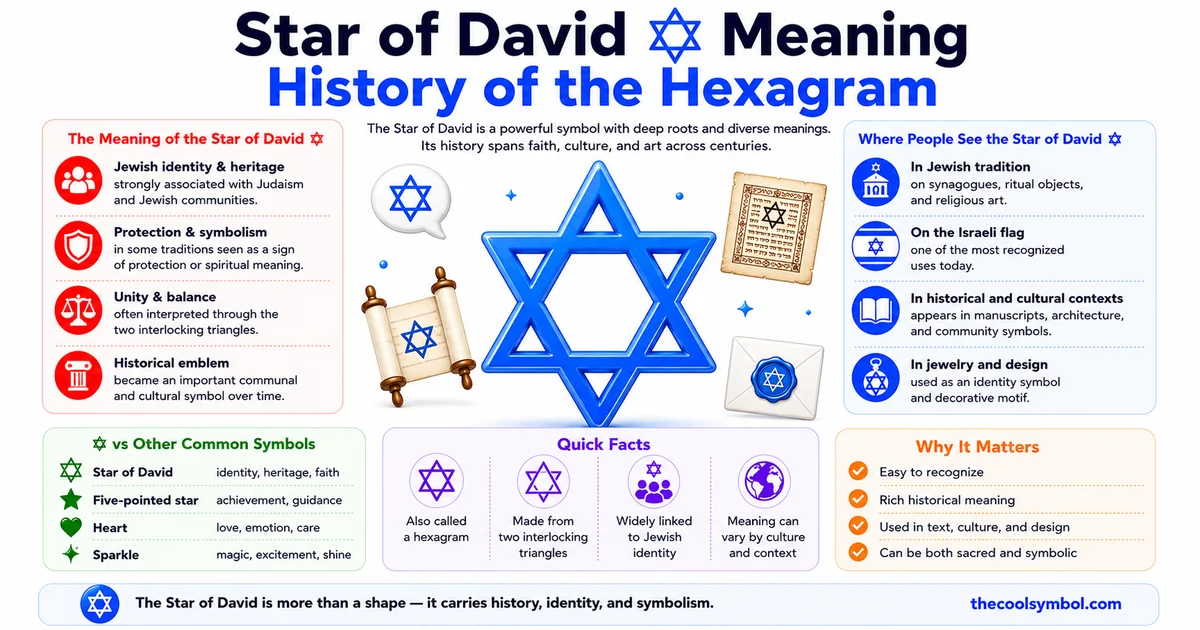
The Star of David is one of the most recognized symbols on Earth. You see it on the flag of Israel, on synagogues, on jewelry and on ceremonial objects around the world.
Most people assume it’s ancient, that it goes all the way back to King David himself three thousand years ago. The real story is stranger and more interesting. The shape is genuinely ancient, but its connection to Jewish identity is surprisingly recent, mostly the last few hundred years.
The six-pointed star also shows up far beyond Judaism, in Hindu temples, Islamic art and medieval alchemy, often with completely different meanings. The same two triangles have meant many things to many cultures.
This guide traces the real history of the Star of David, what its name and shape actually mean, how it became the symbol of Judaism and where else the hexagram appears across cultures.
What the Star of David actually is
The Star of David is a hexagram: a six-pointed star formed by two overlapping equilateral triangles, one pointing up and one pointing down, sharing the same center.
Its Hebrew name is Magen David, which means “Shield of David.” Not “star” at all in the original language. The English term “Star of David” came later. The name connects the symbol to King David, the ancient Israelite ruler, though as you’ll see, that connection is more about tradition than documented history.
The shape itself is simple and symmetrical, which is part of why so many cultures independently arrived at it. Two triangles, six points, six small triangles around a central hexagon. Easy to draw, pleasing to look at and full of geometric meaning for anyone inclined to find it.
The hexagram is far older than its Jewish meaning
Here’s the part that surprises most people. The six-pointed star predates its connection to Judaism by thousands of years. For most of that time it had nothing specifically Jewish about it.
A shape used across the ancient world
From as early as the Bronze Age, the hexagram appeared as a decorative or magical sign across many civilizations, in regions as far apart as Mesopotamia and Britain. Iron Age examples are known from India and the Iberian peninsula. It was a common ornament, not a marker of any one people.
The oldest undisputed example is a seal from the 7th century BCE found in Sidon, belonging to a man named Joshua ben Asayahu. Even there, it carried no special recognizable significance. It was simply a design.
In early synagogues, alongside the pentagram
One of the earliest examples in a Jewish setting is in the synagogue at Capernaum in the Galilee, dating to the 3rd or 4th century CE. The hexagram appears there as a decorative motif, sitting right alongside the five-pointed pentagram. Both were just ornamental patterns, common in buildings of the era, with no exclusive Jewish meaning yet.
This is the key fact about the symbol’s early life. For centuries, Jews and non-Jews used the hexagram side by side as decoration and as a magical sign. It hadn’t yet become the emblem of a people.
How the hexagram became the symbol of Judaism
The transition from a general decorative shape to the emblem of Jewish identity was gradual, spanning centuries, not a single decree.
The name appears in medieval texts
The term Magen David, “Shield of David,” appears in the Babylonian Talmud as an epithet for God rather than a description of the symbol. As a name attached to the six-pointed shape, it shows up in a 13th-century Kabbalistic work called Eshkol ha-Kofer by the Karaite scholar Yehudah Hadassi. Even then, the work didn’t link the symbol to King David or to Jewish identity the way we understand it now.
Throughout the medieval period, the hexagram also appeared on Jewish artifacts: in the Leningrad Codex, a copy of the Hebrew Bible from 1108, plus on coins from the 13th century. In Kabbalah, the mystical tradition of Judaism, it was used on amulets and in architecture.
Prague adopts it
The turning point came in Prague. In the 14th century, the Holy Roman Emperor Charles IV granted the Jews of Prague the right to carry their own flag. They chose the six-pointed star. By the 17th century, the Prague Jewish community had adopted the Star of David as its official symbol.
The 19th century and modern Israel
From Prague, the symbol spread. By the 19th century, the broader Jewish community had widely adopted it as a marker of Jewish identity. When the Zionist movement looked for a unifying symbol, they chose the Star of David precisely because it was already so well accepted. When the modern state of Israel was founded, the Star of David went onto its flag, where it remains today.
So the symbol most associated with Judaism today has only held that role, in the way we recognize it, for roughly the last two hundred years. The shape is ancient. Its meaning as the emblem of a people is modern.
The Star of David through history
From a Bronze Age ornament to the flag of a modern nation, here’s how the six-pointed star traveled.
The pattern echoes other ancient symbols. The shape came first, used widely and loosely. The deep, specific meaning was added by a community over time, until the two became inseparable.
What the Star of David symbolizes
Over the centuries, many meanings have been read into the six-pointed star. These are the most significant in Jewish tradition.
God’s rule over all directions
One central interpretation is that the six points represent God’s rule over the universe in all six directions: north, south, east, west, up and down. The shape becomes a statement that the divine presence extends everywhere.
The connection between God and the Jewish people
In Kabbalistic tradition, the two interlocking triangles represent the bond between God and the Jewish people, or between heaven and earth. The upward triangle reaches toward the divine, the downward triangle reaches toward the world, then they meet as one.
The shield of God
Because Magen David means “Shield of David,” one traditional reading holds that King David, a military hero, didn’t win through his own strength but through the protection of God. The name became a poetic reference to the divine as a protective shield.
Form from a spiritual center
Another idea focuses on the hexagon at the very center of the star. The six points draw their form and substance from that solid core, which represents the spiritual dimension surrounded by the six physical directions.
It’s worth noting that the Star of David does not appear in the Hebrew Bible as a symbol. These meanings were developed by later tradition, especially through Kabbalah and medieval thought, rather than handed down from biblical times.
Want to copy the Star of David or browse other star and symbol designs? Explore the full symbol collection here →. Every star and symbol style, ready to copy and paste anywhere you type.
The hexagram in other cultures and religions
The six-pointed star is not unique to Judaism. The same shape appears across many traditions, usually with its own distinct meaning.
Hinduism: the Shatkona
In Hinduism, the hexagram is called the Shatkona. The upward triangle represents Shiva (the masculine, the divine) and the downward triangle represents Shakti (the feminine, the energy). Together they symbolize the union of opposites and the balance of cosmic forces.
Islamic art and the Seal of Solomon
In Islamic tradition, the hexagram appears as a decorative motif in art and architecture, often called the Seal of Solomon. It adorns many mosques and manuscripts as an ornamental and sometimes protective design, rather than as a religious emblem.
Alchemy and Western esotericism
In medieval alchemy, the hexagram represented the union of opposites: the upward triangle for fire, the downward triangle for water. Combined, they stood for the harmony of the elements. The shape carried this meaning through Western esoteric and occult traditions for centuries.
Buddhism and beyond
Variations of the six-pointed star also appear in some Buddhist contexts and in decorative traditions worldwide. The shape’s balance and symmetry made it a natural choice for representing harmony and the meeting of opposing forces across many belief systems.
Star of David vs the five-pointed star
People sometimes confuse the Star of David with the five-pointed star, but they’re distinct symbols with separate histories.
- Star of David (hexagram): six points, two overlapping triangles, the emblem of Judaism and the state of Israel
- Pentagram (five-pointed star): five points drawn in connected lines, used in ancient Greece, in Christianity and in modern occult and Wiccan traditions
In ancient synagogues the two often appeared together as decoration, which shows how loosely both shapes were used before they took on their specific later meanings. Today they belong to completely different symbolic worlds.
What the Star of David teaches about symbols
The Star of David is a perfect example of how symbols actually work. Meaning isn’t built into a shape. It’s added by people, over time, through use and tradition.
This is the same process that shaped every enduring symbol. The heart symbol traveled a similar road from an ancient shape to the sign of love, gaining its meaning gradually over centuries rather than being born with it.
A shape starts as decoration or coincidence. A community adopts it. Meaning accumulates. Eventually the symbol and the meaning feel inseparable, even though they arrived separately and the link is far younger than the shape. The Star of David, ancient in form but modern in meaning, shows this clearly.
The same layering happens with everyday symbols too. A single shape can split into many meanings depending on color and context, the way the green heart came to mean friendship, nature and even jealousy, or the way the broken heart came to carry both real grief and playful drama. Culture keeps writing new meaning onto old shapes.
3 common misconceptions about the Star of David
1. That it was King David’s actual shield
The name “Shield of David” leads many to picture the symbol on the shields of King David’s army three thousand years ago. There’s no biblical or archaeological evidence for that. The name and the symbol’s Jewish meaning developed much later, mainly through medieval tradition.
2. That it has always been exclusively Jewish
For most of its history, the hexagram was a general decorative and magical shape used across many cultures. Its exclusive association with Judaism is relatively recent, strengthening mainly from the 17th century onward.
3. That it appears in the Hebrew Bible
The Star of David as a symbol does not appear in the Hebrew Bible. Its meanings come from later Jewish tradition, especially Kabbalah and medieval thought, not from biblical scripture.
Wrapping up
The Star of David carries thousands of years of history in its six simple points. The shape is genuinely ancient, used as decoration and as a magical sign from the Bronze Age across much of the world. Its meaning as the emblem of Judaism, though, is the work of the last few centuries, crystallizing in Prague and spreading to become the symbol on the flag of Israel.
The same hexagram lives in Hindu temples as the Shatkona, in Islamic art as the Seal of Solomon and in alchemy as the union of fire and water. One shape, many meanings, each given by a different culture across time.
That’s the deeper lesson of the Star of David. A symbol means what people decide it means, so that meaning can grow, change and deepen long after the shape itself was first drawn.