
Pi Symbol π: What It Means in Math and Why It Has Its Own Day
By The Cool Symbol Team on 2026-08-01
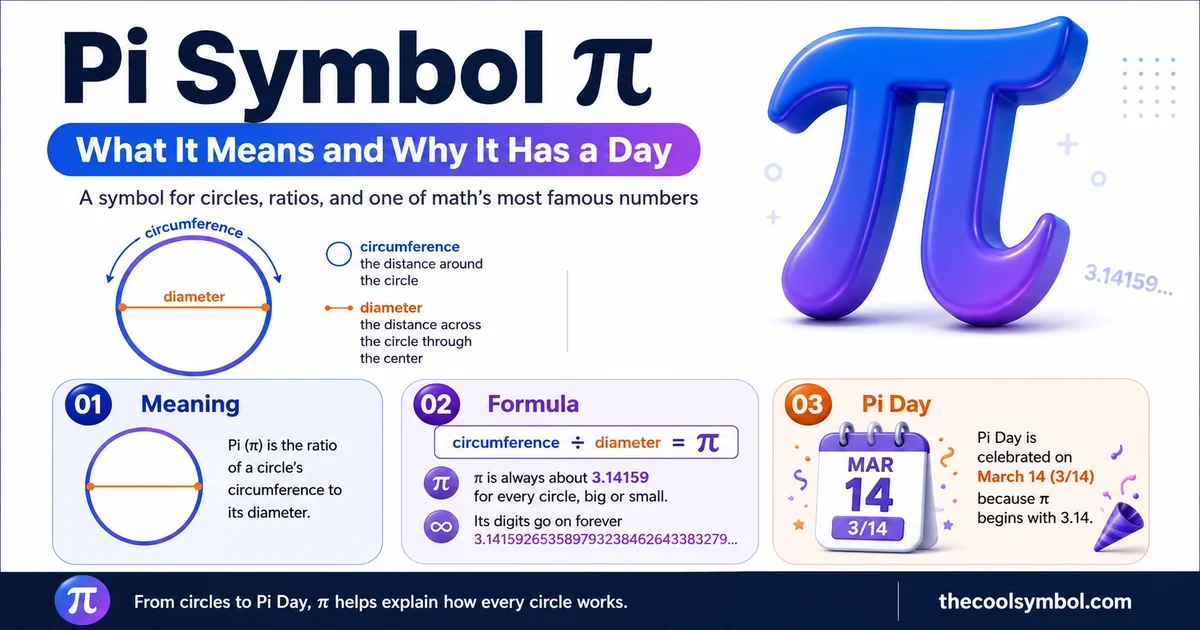
You’ve seen the symbol π in math class. It looks like a little table with two legs. Most people remember it as “3.14” and not much more.
But π (called pi) is one of the most amazing numbers in all of math. It hides inside every circle in the world. And it’s so loved that it even has its own holiday, celebrated every year on March 14.
Here’s the wild part. This one number never ends. It goes on forever, with no pattern, so no one can ever write it out fully. People have used computers to find trillions of its digits, yet it still keeps going.
In this guide you’ll learn what pi means, where its symbol came from, why it never ends and why it gets its very own day each year. It’s an easy and fun story about one special number.
What does pi actually mean?
Pi is all about circles. It’s the same for every circle, no matter how big or small.
Here’s the simple idea. Take any circle. Measure the distance all the way around it (that’s called the circumference). Then measure the distance straight across the middle (that’s the diameter). Now divide the first number by the second.
You will always get the same answer: about 3.14. Every single time, for every circle in the world. A tiny coin, a car tyre, the moon, it doesn’t matter. The distance around is always about 3.14 times the distance across.
That fixed number is pi. It’s a hidden rule built into every circle. And because it never changes, it’s one of the most useful numbers in all of math and science.
The number that never ends
Most numbers are simple. But pi is special, because it never stops and never repeats.
You probably know pi as 3.14. But that’s just the start. The real number is 3.14159265358979, then it keeps going. Forever. The digits go on and on with no pattern that ever repeats.
Math people have a name for this kind of number. They call it “irrational.” That doesn’t mean it’s crazy. It just means the number cannot be written as a simple fraction, so its digits never end. A mathematician named Johann Lambert proved this back in 1768.
People have used powerful computers to find more than 100 trillion digits of pi. And it still doesn’t end. But here’s a fun fact: for almost any real job, you only need about 40 digits. That’s enough to measure across the whole known universe and be off by less than the width of a single atom.
This “goes on forever” idea links pi to another famous symbol. Just like the infinity symbol stands for something with no end, pi is a real number that truly never stops. One is an idea of endlessness. The other is a number that lives it out.
Where the π symbol came from
The number pi is very old. People knew about it thousands of years ago. But the symbol π that we use for it is much newer.
The number itself goes back about 4,000 years. The ancient Babylonians and Egyptians knew a circle had this special ratio. Later, the famous Greek thinker Archimedes worked out a very close value for it around 250 BC. So the idea is ancient.
But for most of history, there was no single symbol for it. People wrote it out in long words or used rough fractions. That finally changed in the year 1706.
A Welsh mathematician named William Jones was the first to use the Greek letter π for this number. He picked it because π is the first letter of the Greek word for “periphery,” which means the edge or the distance around. Since pi is all about the distance around a circle, the letter fit perfectly.
At first, not many people used it. Then a brilliant mathematician named Leonhard Euler started using π in his own books around 1737. Euler was so famous and well-read that once he used it, everyone else did too. According to the Exploratorium, the science museum that started Pi Day, this is how π became the standard symbol we all know today.
Pi, explained in one picture
The whole idea of pi fits into one simple picture. Here it is.
That’s really all pi is: the distance around a circle divided by the distance across it. Simple to say, but it leads to a number that goes on forever.
Want to copy the pi symbol or find other math and fun symbols? See the full symbol collection here →. Every symbol, from π to ∞, hearts and stars, ready to copy and paste anywhere you type.
Why pi has its own day
Pi is the only number with its own holiday. It’s called Pi Day, held every year on March 14.
The reason is a clever little trick with dates. In the American way of writing dates, March 14 is written as 3/14. And the first three digits of pi are 3, 1 and 4. So 3/14 looks just like 3.14. That’s why March 14 was chosen.
Pi Day started in 1988. A physicist named Larry Shaw came up with the idea at a science museum in San Francisco called the Exploratorium. People celebrated by walking in circles and eating pie, because “pie” sounds just like “pi.” It was a fun way to enjoy math.
The idea grew and grew. In 2009, the United States government officially made March 14 National Pi Day. Now schools and math fans all over the world celebrate it every year with pie, puzzles and circle games.
A birthday bonus
Here’s a fun coincidence. The famous scientist Albert Einstein was born on March 14, 1879. So Pi Day is also Einstein’s birthday. For math and science fans, that makes March 14 an extra special date.
Where pi is used in real life
Pi is not just a math class idea. It’s used everywhere in the real world, often in ways you never see.
- Anything round: finding the size of wheels, pipes, cans, plates and circles of all kinds
- Building and engineering: designing bridges, tunnels, domes and arches
- Space travel: working out the paths of planets and spacecraft, which move in curves
- Waves: pi helps describe sound waves, light waves and radio signals
- Technology: it’s used inside GPS, phone signals and many machines
Any time something is round, or moves in a curve or a wave, pi is usually involved. It’s one of the quiet workhorses of science. You use things built with pi every single day without knowing it.
What the pi symbol teaches us
The story of pi shows a neat truth about symbols. A single small mark can stand for a huge, deep idea.
The letter π is tiny. You can draw it in a second. But it holds one of the most amazing numbers ever found, a number that never ends and lives inside every circle. That’s a lot of meaning packed into one little shape.
This is true for many symbols. A pound sign grew from a single Latin letter into a sign known around the world. A small shape becomes a big idea. Pi did the same, going from the first letter of a Greek word to the symbol for a number that shapes all of science.
It’s also a symbol that people feel proud of and enjoy, a bit like how a five-pointed star means so much to different people. Pi has fans, a holiday and even memory contests. Few numbers are loved the way pi is.
3 things people get wrong about pi
1. That pi is exactly 3.14
3.14 is just a short, rounded version. The real pi goes on forever with no end. We use 3.14 to make math easy, but the true number never stops.
2. That the symbol is as old as the number
The number pi is about 4,000 years old, but the symbol π is not. It was first used in 1706 by William Jones. So the idea is ancient, but the little letter is fairly new.
3. That pi is only used in school
Pi feels like a classroom thing, but it’s used all over the real world: in building, space travel, technology and anything round. It’s one of the most useful numbers there is.
Wrapping up
The pi symbol π stands for one very special number: the distance around any circle divided by the distance across it, which is always about 3.14. The number is ancient, but the symbol was first used by William Jones in 1706 and made popular by Leonhard Euler soon after.
Pi is an irrational number, which means its digits never end and never repeat. It’s so loved that it has its own holiday, Pi Day, on March 14, which also happens to be Einstein’s birthday. And it’s used everywhere, from wheels to spacecraft.
So the next time you see that little two-legged symbol, remember it holds a number with no end, hidden inside every circle in the universe. Not bad for one small Greek letter.