
What Does the Five-Pointed Star ★ Symbolize Across Cultures?
By The Cool Symbol Team on 2026-06-19
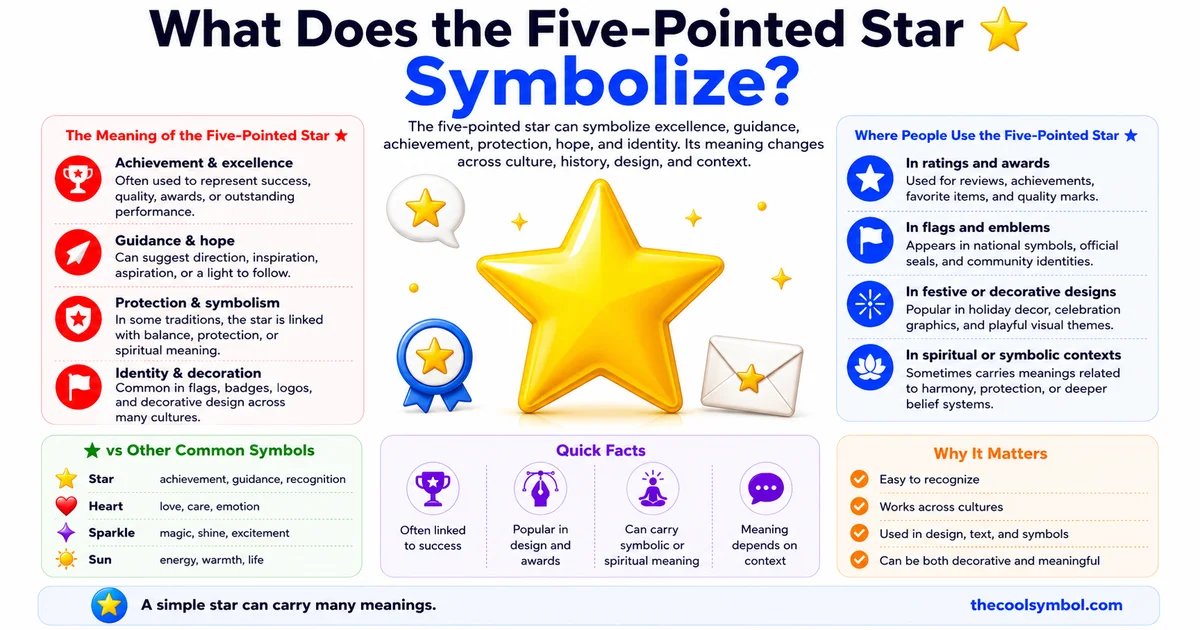
You see the five-pointed star everywhere. On flags, on military uniforms, on hotel ratings, on your favorite app’s review score, on a witch’s pendant in a horror movie.
Same shape, wildly different meanings. To one person it means excellence. To another, spiritual protection. To another, a national identity. To another, something occult and a little spooky. The five-pointed star might be the most loaded simple shape humans have ever drawn.
And it’s old. Really old. The five-pointed star shows up on clay tablets from 5,500 years ago, long before it meant magic, religion or a five-star hotel.
This guide traces what the five-pointed star means across cultures and history, from ancient Sumer to modern flags, why it picked up its mystical reputation and how the same shape ended up meaning both “sacred” and “top quality.”
The five-pointed star’s main meanings
The five-pointed star carries several major meanings depending on culture and context.
- Excellence and achievement (star ratings, gold stars, star performers)
- Spiritual protection and the five elements (the pentagram tradition)
- National identity and unity (stars on flags around the world)
- Guidance and hope (the guiding star, wishing on a star)
- The occult and magic (the pentagram in modern pop culture)
The shape stayed the same for thousands of years. The meanings layered on top of each other, culture by culture, until one simple star could mean almost anything depending on where you saw it.
The ancient origins of the five-pointed star
The five-pointed star is one of the oldest symbols humans have used. Its story starts in the cradle of civilization.
Sumer and Babylon
Archaeologists found pentagram markings on Sumerian clay tablets dating back about 5,500 years. The surprise is that they weren’t magical. They were practical: early markers used to indicate directions and regions in one of the world’s first writing systems.
The Babylonians who followed gave the star deeper meaning. They used it as a protective sigil and a symbol of cosmic order, weaving it into their religious imagery and connecting it to their gods. The star’s link to protection starts here, thousands of years ago.
Ancient Greece and Pythagoras
The Greeks elevated the five-pointed star from a practical mark to a symbol of deep meaning. The mathematician Pythagoras and his followers discovered the golden ratio hidden inside the pentagram’s geometry, which they considered close to divine.
The Pythagoreans assigned the five points to the five elements they believed made up the world: fire, water, air, earth and a fifth element variously called psyche or spirit. This idea, that the star represents the building blocks of everything, echoes through every later mystical tradition.
Ancient Egypt
Egyptian art featured five-pointed stars as emblems connected to the Duat, the world of the afterlife. The star wasn’t as central in Egypt as in Mesopotamia, but it carried a clear otherworldly, celestial association tied to the night sky and what lay beyond death.
The five-pointed star in religion
As major religions spread, they each gave the five-pointed star their own meaning. Some embraced it, some grew wary of it.
Christianity
In medieval Christianity, the five points of the star represented the five wounds of Christ from the crucifixion. The pentagram was a protective symbol used to ward off evil. Roman emperors had earlier used it as a seal or amulet.
The most famous Christian use appears in the 14th century English poem Sir Gawain and the Green Knight. Gawain bears a golden pentagram (called a pentangle) on his shield, described as an “endless knot.” Its five points stand for the five knightly virtues and divine protection. For medieval knights, the star meant honor and faith.
Judaism
While the six-pointed Star of David is the better-known Jewish symbol, the five-pointed star has also been linked to the five books of the Torah (the Pentateuch) and to divine truth in some traditions.
Islam
The five-pointed star appears alongside the crescent on many flags of Muslim-majority nations. In some interpretations the five points represent the Five Pillars of Islam. The star-and-crescent became a widely recognized emblem across the Islamic world.
The star’s journey through history
From a practical Sumerian mark to a five-star review, here’s how the meaning evolved.
Notice the pattern. The star never lost its old meanings. It just kept gaining new ones. Today all of them coexist, which is why the same shape can feel sacred, national, spooky or simply excellent depending on context.
How the star became the pentagram (and got its spooky reputation)
The five-pointed star’s mystical reputation is real, but it’s far more recent than most people assume.
For most of history, the upright five-pointed star was a positive symbol: protection, the elements, divine proportion, Christian virtue. The shift toward something darker came mainly in the 19th century.
In 1855, the French occultist Eliphas Levi wrote about the difference between an upright pentagram and an inverted one. He framed the upright star (single point up) as representing spirit ruling over matter, a positive force. The inverted star (two points up) he linked to the opposite: matter over spirit. Later writers pushed the inverted version further toward dark associations. In 1897 an inverted pentagram with a goat’s head was popularized.
That 19th and 20th century reframing, amplified by Hollywood horror films, gave the pentagram its modern “occult” image. But it’s worth remembering: for thousands of years before that, the same star meant protection and the sacred. Orientation and cultural context decide the meaning, not the shape itself.
Pentagram vs pentacle
People mix these up constantly. A pentagram is the five-pointed star drawn with five connected lines. A pentacle is that same star enclosed in a circle. In modern witchcraft and Wicca, the pentacle (star in a circle) is a positive symbol of protection and the unity of the five elements, point up. The circle represents wholeness and the eternal.
Want to copy the five-pointed star or browse other star symbols? Explore the full star and symbol collection here →. Every star style, from ★ solid to ☆ outline and beyond, ready to copy and paste anywhere you type.
The five-pointed star on flags around the world
More national flags use the five-pointed star than almost any other symbol. Each one means something specific to that country.
- United States: 50 stars for the 50 states, representing unity and (in the original design language) excellence
- China: five stars symbolizing the unity of the Chinese people, with the large star for the Communist Party
- European Union: a circle of 12 five-pointed stars representing unity and solidarity among nations
- Morocco: a green five-pointed pentagram chosen for its historic significance and connotations of health and security
- Vietnam, Somalia, Turkey, Pakistan and many more: stars standing for independence, faith or national unity
The reason the star is so popular on flags traces back to its ancient symbolism. It already meant guidance, unity and the sacred. Nations adopted it to project those same ideas onto their identity.
Why the star means “excellence” today
Strip away the religion and the flags and the most common modern use of the five-pointed star is rating quality. Five stars means the best. One star means avoid.
This comes from the star’s long association with the sky, with reaching high, with the exceptional. To “be a star” means to stand out. A “star performer” is the best in the group. Gold stars reward children for good work. Hotels, restaurants and apps live and die by their star ratings.
The star traveled a long road to get here. From a Sumerian direction marker to a Pythagorean sacred shape to a Christian symbol of virtue to, finally, the universal shorthand for “this is good.” The thread connecting all of it is the idea of something elevated, something above the ordinary.
Other modern uses
- Wishing: “wish upon a star” and the guiding star of hope
- Fame: the Hollywood Walk of Fame, star-studded events, celebrity “stars”
- Military: rank insignia, with more stars meaning higher rank
- Favorites: the star icon to bookmark or favorite something online
How the star compares to other popular symbols
The five-pointed star sits in a different emotional category than the symbols people use for feelings.
Where the red heart speaks directly about love and affection, the star speaks about achievement, guidance and the sacred. Hearts are about connection between people. Stars are about reaching upward.
And where the black heart carries a moody, modern, sometimes ironic tone, the star carries weight from thousands of years of history. One is a recent digital mood. The other is an ancient sacred shape.
Even the friendlier symbols differ. The green heart with its meaning of friendship and nature is warm and personal, while the star tends to feel aspirational and public, the symbol you put on a flag rather than send to a friend.
3 common misconceptions about the five-pointed star
1. That the pentagram is inherently evil
It isn’t. For thousands of years the upright five-pointed star meant protection, the elements and the sacred. Its dark reputation is a recent invention, mostly from 19th century occultism and Hollywood. The upright star, especially the pentacle in a circle, is a positive symbol in most traditions that use it.
2. That pentagram and pentacle are the same
They’re related but distinct. The pentagram is the bare five-pointed star. The pentacle is the star enclosed in a circle. The circle adds meanings of wholeness and protection, which is why the pentacle is the form used positively in modern witchcraft.
3. That the star always meant something mystical
The very first known uses, on Sumerian clay tablets, were practical markers for directions and regions. The mystical meanings came later. The star started as a useful sign and only gradually became sacred.
Wrapping up
The five-pointed star is proof that a symbol’s meaning lives in culture, not in the shape. The same five points have meant a direction marker, the five elements, the wounds of Christ, knightly virtue, national unity, occult power and five-star quality. All at different times, now all at once.
When you see a five-pointed star, the context tells you which meaning applies. On a flag it’s national pride. On a review it’s quality. On a pendant it might be spiritual. In a horror film it’s set dressing. The shape is ancient and constant. The meaning is whatever the moment makes it.
Next time you leave a five-star review, you’re using a symbol that started as a mark on Sumerian clay 5,500 years ago. Not bad for five simple lines.