
Arrow Symbols → ↑ ⇒: What Each Direction Actually Means in Design & Text
By The Cool Symbol Team on 2026-06-27
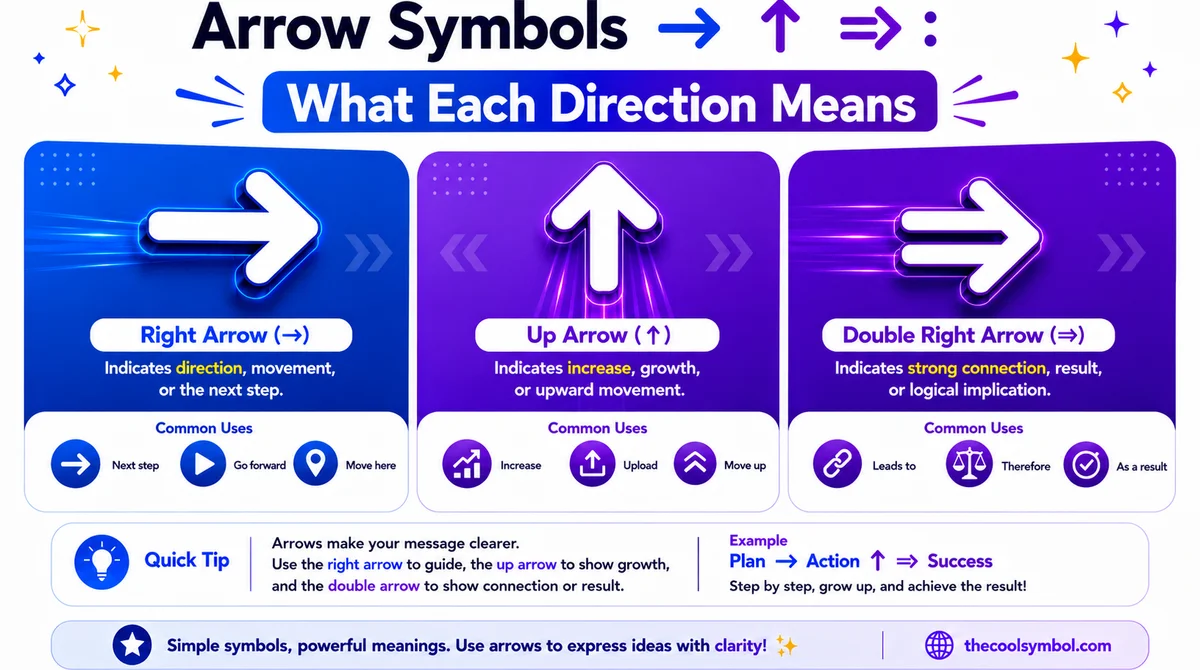
You use arrow symbols every day without thinking about them. The back button, the scroll indicator, the “next” on a slideshow, the little arrow that points to a link in someone’s bio.
But arrows carry more meaning than just “go this way.” A single arrow, a double arrow and a curved arrow all say different things. An up arrow next to a number means something specific. In math, a right arrow and a double right arrow are not interchangeable. Designers and writers who know these differences communicate more clearly.
There are more than 600 arrow symbols in Unicode, but you only need to understand a couple dozen and the logic behind them. Once you know what each shape and direction signals, you’ll pick the right arrow every time.
This guide breaks down what arrow symbols mean by direction and style, where the arrow symbol came from, how each type is used in design, text and math and which arrow to reach for in any situation.
What arrow symbols mean, by direction
Direction is the first layer of meaning. Each way an arrow points carries a common, widely understood sense.
- Right arrow (→): forward, next, proceed, “go to,” cause and effect
- Left arrow (←): back, previous, return, undo
- Up arrow (↑): increase, scroll up, upload, higher, top
- Down arrow (↓): decrease, scroll down, download, lower, expand a menu
- Diagonal arrows (↗ ↘ ↙ ↖): movement in a corner direction, growth or decline trends
- Bidirectional arrow (↔ ↕): two-way, swap, resize, a relationship between two things
These are nearly universal. A right arrow means forward almost everywhere on Earth, which is exactly why arrows work so well on signs in airports and roads where people speak different languages.
Where the arrow symbol came from
The arrow as a directional symbol is surprisingly modern. The weapon is ancient, but using a little arrow shape to mean “this way” is only a few centuries old.
According to Wikipedia’s history of the arrow symbol, the use of the arrow as a directional mark does not appear to pre-date the 18th century. One of the earliest known examples is in a 1737 French engineering treatise by Bernard Forest de Belidor, where an arrow shows the direction of flowing water and a turning water wheel.
From there, mapmakers began using arrows to show the flow of rivers and the movement of armies. Through the 19th century, the symbol grew more abstract: the feathered fletching of a real arrow was dropped, leaving the clean line-and-head shape we use today.
The arrow then found a second home in mathematics. The right arrow as a symbol for logical implication was introduced by the mathematician David Hilbert in 1922. The double-headed arrow followed in 1933. That’s the origin of the meaningful difference between a single and a double arrow, which still holds today.
In 1991, the first version of Unicode included 130 arrows. Today there are more than 600, scattered across several code blocks, with the core set living in the Arrows block. The humble directional mark became one of the most encoded symbol families in computing.
Single vs double arrows: the difference that matters
This is the distinction most people miss, yet it changes meaning, especially in technical and mathematical writing.
Single arrow (→)
The everyday arrow. It means “goes to,” “leads to,” “next” or a simple mapping from one thing to another. In math and logic, a single right arrow often denotes a function: it maps an input to an output. In flowcharts and instructions, it means “then” or “proceed to.”
Double arrow (⇒)
The double arrow carries more weight. In formal logic and math, it means “implies” or “therefore.” A double right arrow says that the first statement logically forces the second. It’s a stronger, more specific claim than the single arrow’s simple “leads to.”
A double-headed arrow that points both ways (⇔) goes further still, meaning “if and only if,” a two-way logical equivalence. So in technical writing, picking single versus double isn’t a style choice. It changes the logical meaning of what you wrote.
Arrow types and what each one signals
Beyond direction, the style of the arrow adds meaning. Here’s how to read the most common types.
The pattern: straight arrows are about direction and flow, curved arrows are about returning or repeating, while double arrows are about stronger or two-way relationships. Once you see those families, every arrow makes sense.
Want to copy any of these arrow symbols or browse the full set? Explore the complete arrow and symbol collection here →. Every arrow style, from simple → to curved, double and decorative, ready to copy and paste anywhere you type.
How arrows are used in design
In interface and graphic design, arrows do specific, well-understood jobs. Using the expected arrow for each job keeps your design clear.
Navigation
Left and right arrows move between screens, slides or pages. The left arrow is almost always “back” and the right arrow is “forward” or “next.” Breaking this convention confuses people instantly, so it’s one to respect.
Dropdowns and expansion
A down arrow (or a downward chevron) signals “there’s more below, tap to expand.” When the menu opens, the arrow often flips to point up, showing it can be collapsed again. This little rotation is a tiny but powerful piece of feedback.
Calls to action
A right arrow after a button label (“Get started →”) adds a sense of forward momentum. It signals progress and pulls the eye toward the action. This is why so many call-to-action buttons end with an arrow.
Trends and data
Up and down arrows next to numbers show increase and decrease at a glance. Green up arrow, good. Red down arrow, bad. This shorthand powers every stock ticker, dashboard and analytics screen.
Logos and brand marks
Many famous logos hide an arrow. The FedEx logo has an arrow between the E and the x, suggesting forward motion and delivery. The Amazon smile is also an arrow, pointing from A to Z. Designers love arrows because they add an unconscious sense of direction and progress.
How arrows are used in text and messaging
Arrows have become a handy text tool, especially in bios, captions and quick instructions.
- Pointing to a link: “New blog post ↓” or “Tap the link →”
- Showing steps: “Sign up → verify email → start using”
- Directing attention: “Best coffee in town, this way →”
- Showing change: “My mood today: tired → caffeinated → unstoppable”
- Decorative framing in headings and quotes
In casual text, arrows compress a sequence into a single clean line. “Tired → coffee → alive” tells a whole story in three words and two arrows. They’re efficient and they read instantly.
How arrows are used in math and logic
This is where arrow precision matters most. Each arrow type has a defined meaning in mathematical and logical notation.
- Single right arrow (→): defines a function or a mapping from one set to another, also “approaches” in limits
- Double right arrow (⇒): logical implication, “if this, then that”
- Double bidirectional arrow (⇔): logical equivalence, “if and only if”
- Maps-to arrow (↦): shows how a specific element is mapped to its result
- Up and down arrows (↑ ↓): can denote increasing or decreasing sequences, or specific operations in advanced notation
In a math proof, swapping a single arrow for a double arrow can turn a definition into a false claim. This is why the difference isn’t pedantic. It’s the difference between saying “maps to” and “proves.”
Arrow symbolism across cultures
Beyond function, arrows carry older cultural meanings, especially tied to their origin as a weapon and a tool.
In Native American symbolism, arrows carry rich meaning. A single arrow can represent direction or protection. Two arrows pointing in different directions symbolize war, while crossed arrows symbolize friendship and a broken arrow represents peace. These meanings still show up in jewelry, tattoos and design today.
The arrow’s link to focus and forward motion also made it a natural symbol for ambition and direction in life. An arrow has to be pulled backward before it launches forward, an image used in countless motivational sayings about setbacks leading to progress.
How arrows compare to other symbols
Arrows belong to the broad family of functional symbols, the ones that do a job rather than carry an emotion. They sit apart from the more expressive symbols people use to convey feeling.
Where a five-pointed star carries layered cultural and symbolic meaning, an arrow is almost purely functional. The star means excellence, protection or the sacred. The arrow just means direction, which is exactly why it works so well on signs.
And where the sparkles emoji adds emotional flair and emphasis, or the shooting star carries wishes and wonder, arrows stay neutral and practical. That neutrality is their strength. An arrow never gets in the way of the message, it just points you toward it.
3 common mistakes with arrow symbols
1. Using a double arrow when you mean a single one
In technical writing, math or logic, a double arrow means “implies,” not just “goes to.” Using it casually where you meant a simple single arrow can confuse a technical reader or even state something false. Match the arrow to the meaning.
2. Breaking navigation conventions
Left means back, right means forward. Putting a left arrow on a “next” button or a right arrow on “back” disorients users instantly. These conventions are deeply learned, so respect them in interface design.
3. Overloading text with arrows
Arrows are efficient, but a caption stuffed with five different arrow styles becomes hard to read. Use them to clarify direction or steps, not as constant decoration. One clear arrow beats five competing ones.
Wrapping up
Arrow symbols look simple, but they carry a precise language of direction, flow and relationship. Direction gives the first meaning, style adds the second. A single arrow leads, a double arrow implies, a curved arrow returns and a circular arrow repeats.
Learn the handful of core types and the logic behind them, then you’ll always pick the right arrow, whether you’re designing a button, writing a set of steps or setting down a line of math. The difference between a clear instruction and a confusing one is often a single, well-chosen arrow.
More than 600 arrows exist in Unicode, but the meaning all comes down to a few simple patterns you now know.