
Em Dash — vs En Dash – vs Hyphen -: Meaning and When to Use Each
By The Cool Symbol Team on 2026-08-29
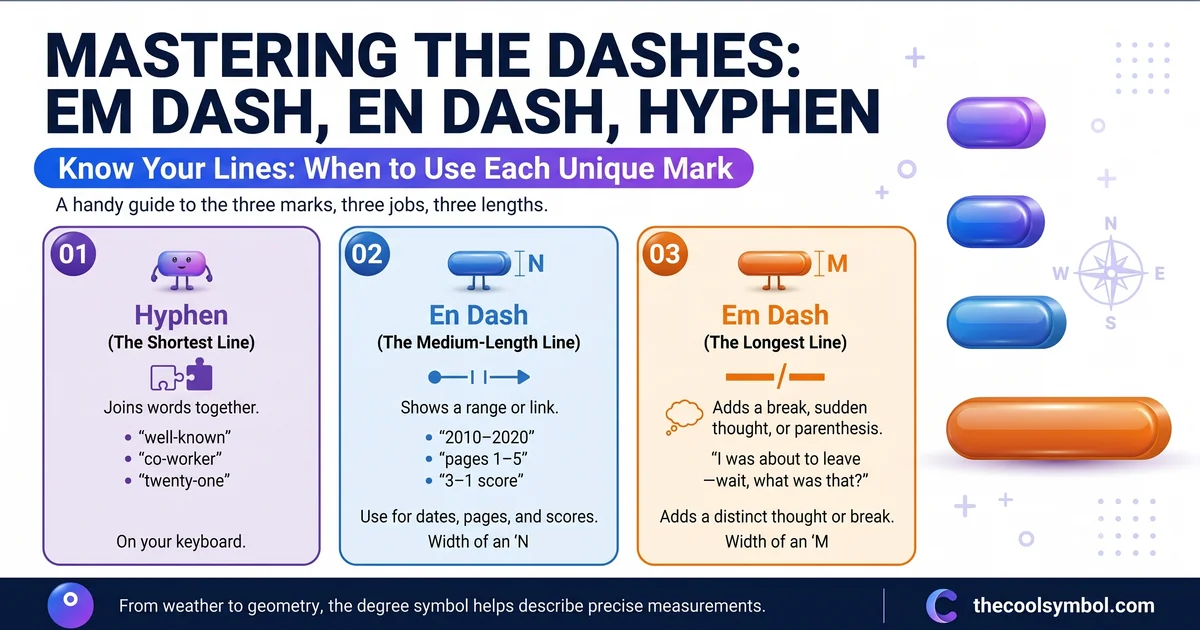
They look almost the same. Three little horizontal lines, each a different length. But use the wrong one and your writing can look careless or even change its meaning.
The hyphen (-), the en dash (–) and the em dash (—) are three separate marks. Each one has its own job. Most people use them wrong because they never learned the difference. But once you know the rules, it takes about five seconds to pick the right one.
Here’s the simple version. A hyphen joins words. An en dash shows a range. An em dash adds a thought. That’s most of what you need to know.
In this guide you’ll learn what each one does, when to use it, how to type it and the easy memory trick that keeps them straight. Plain words, clear examples, no confusion.
The quick difference
All three are horizontal lines. The difference is the length and the job.
- Hyphen (-): the short one. Joins words together. You see it on your keyboard.
- En dash (–): the medium one. About as wide as the letter N. Shows a range between two things.
- Em dash (—): the long one. About as wide as the letter M. Breaks into a sentence to add extra information.
The names tell you the size. En comes from the letter N. Em comes from the letter M. M is wider than N, so the em dash is longer than the en dash. That’s all the names mean.
The hyphen (-): joining words together
The hyphen is the one you already know. It’s the short line on your keyboard, right next to the zero key. Its job is to connect words that work together as a unit.
When to use a hyphen
- Compound words: well-known, mother-in-law, ice-cream
- Prefixes: re-enter, co-worker, self-made
- Compound adjectives before a noun: a five-year-old child, a high-speed train
- Spelled-out numbers: twenty-one, sixty-five
The key idea is that a hyphen ties things together. The two words on either side become one unit. There are no spaces around a hyphen. The words touch it directly.
One helpful tip: if a compound word has been used long enough, it often loses its hyphen over time. “Email” used to be “e-mail.” “Online” used to be “on-line.” When in doubt, check a dictionary.
The en dash (–): showing a range
The en dash is the middle-sized line. It’s a little longer than a hyphen but shorter than an em dash. Its main job is to show a range or a connection between two things.
When to use an en dash
- Ranges of numbers: pages 10–25, the years 2010–2020
- Scores: the match ended 3–1
- Replacing “to” or “and”: the London–Paris train, the teacher–student relationship
- Complex compound adjectives: a post–World War II building
Think of the en dash as a connector between two equal things. It says “from this to that” or “between this and that.” Whenever you could say “to” between two numbers or names, an en dash is the right pick.
In most styles, there are no spaces around an en dash. The words or numbers touch it directly, just like a hyphen.
The em dash (—): adding a thought
The em dash is the longest of the three. As Wikipedia’s article on dashes explains, it gets its name from being roughly the width of a capital letter M in traditional printing.
Its job is to break into a sentence and add extra information, a bit like parentheses or commas, but with more punch. It makes the added thought feel important rather than tucked away.
When to use an em dash
- To set off extra information: “The answer—believe it or not—was right in front of us.”
- To replace a colon: “She had one goal—to finish the race.”
- To show a sudden change of thought: “I was about to leave—wait, what was that noise?”
- To show interrupted speech in dialogue: “I think we should—” “No, let me finish.”
The em dash adds drama. It catches the reader’s eye and says “pay attention to this part.” That’s why it’s stronger than a comma or parentheses. Use it when you want the extra thought to stand out, not blend in.
In American writing, the em dash has no spaces around it. In British writing, some people use an en dash with spaces on each side instead. Both styles are correct. Just pick one and stick with it.
All three at a glance
Here’s the whole thing in one simple chart.
Short joins words. Medium shows ranges. Long adds thoughts. That one idea covers most situations.
Want to copy these dashes or browse other useful punctuation and symbols? See the full symbol collection here →. Every mark, from dashes to arrows, stars and more, ready to copy and paste anywhere you type.
How to type each one
The hyphen is easy. It’s right on your keyboard. But the en dash and em dash are hidden, so here’s how to find them.
En dash
- Windows: hold Ctrl and press the minus key on the number pad
- Mac: press Option + hyphen
- Phone: hold down the hyphen key and the en dash appears as a choice
Em dash
- Windows: hold Ctrl + Alt and press the minus key on the number pad
- Mac: press Option + Shift + hyphen
- Phone: hold down the hyphen key and pick the longest option
- Quick trick: in many apps, typing two hyphens (–) auto-corrects to an em dash
The quickest way of all is to copy the character from a symbols page and paste it wherever you need it.
The easy memory trick
Here’s a simple way to remember which is which.
Think of the length as matching the size of the job. A hyphen is small because it does a small job: joining two words. An en dash is medium because it bridges two things. An em dash is big because it breaks into a whole sentence.
Small mark for small jobs. Big mark for big jobs. That pattern holds almost every time.
What dashes show us about symbols
Dashes are a great example of how small differences in a symbol’s shape can change its whole meaning. A longer line does a completely different job than a shorter one.
You see the same idea in math. The sigma symbol means different things depending on whether it’s big or small. Big sigma adds up numbers. Small sigma measures spread. Same letter, different size, different meaning. Dashes work the same way.
Symbols often carry more weight than their size suggests. The infinity loop is one small shape that holds one of the biggest ideas in math. Three dashes do the same thing on a smaller scale: three nearly identical lines, three completely different jobs.
It’s also worth noting that these marks evolved over time, just like the pound sign grew slowly from a Latin letter into a money symbol. Dashes didn’t have strict rules until printing became standard. The rules we follow today were set by style guides over the last few centuries.
3 common mistakes
1. Using a hyphen when you need a dash
A hyphen is not a short dash. If you write “pages 10-25” with a hyphen, it should really be an en dash: “pages 10–25.” The hyphen joins words; the en dash shows a range.
2. Using too many em dashes in one piece
One or two em dashes in a paragraph can add punch. Five of them make your writing feel choppy and hard to follow. Use them for special moments, not every other sentence.
3. Mixing up spaces
In American style, no spaces go around an em dash. In British style, spaces go on both sides of an en dash used in the same way. Pick one style and stay with it. Mixing them looks messy.
Wrapping up
The hyphen (-), en dash (–) and em dash (—) are three different marks with three different jobs. The hyphen joins words. The en dash shows ranges. The em dash breaks into a sentence to add a thought.
Remember the size trick: small mark for small jobs, big mark for big ones. The names tell you the width: en is the width of N, em is the width of M. Once you know that, picking the right one takes no time at all.
Get these three little lines right. Your writing will look cleaner, read better and feel more polished. Three marks, three rules, one clear difference.