
Ellipsis … Meaning: What Three Dots Really Communicate in Text
By The Cool Symbol Team on 2026-08-29
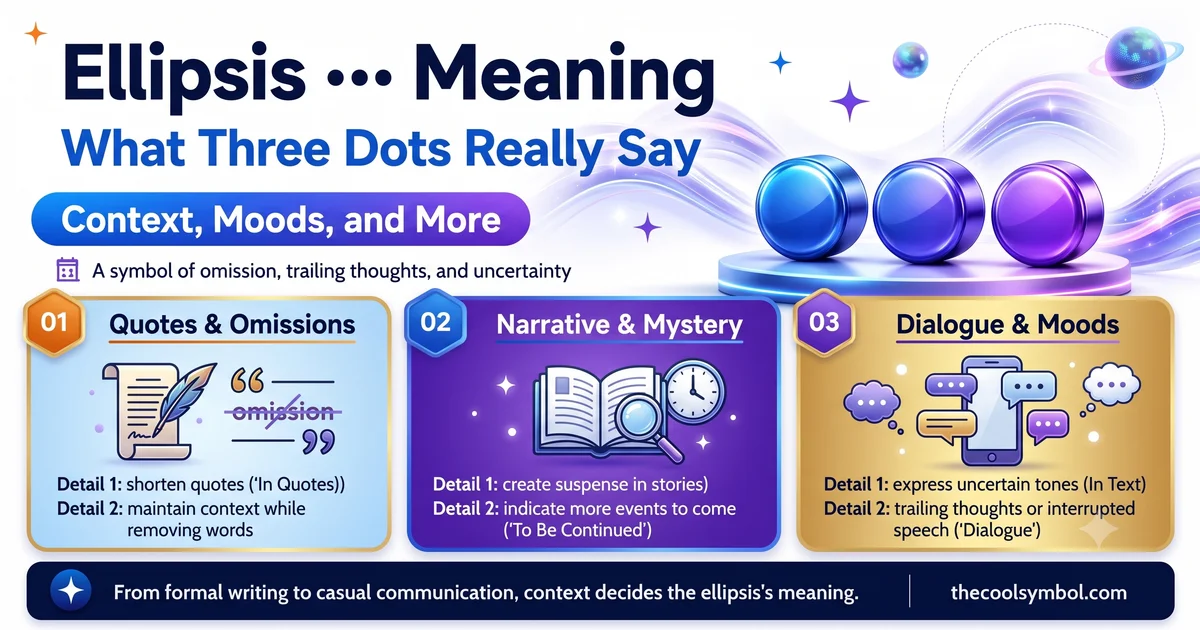
Three dots. That’s it. Just three small dots in a row: …
But those three dots do more work than most punctuation marks. They can show that words are missing from a quote. They can make a sentence trail off into silence. They can build suspense. In a text message, they can make “ok” sound completely different.
The ellipsis is one of the few punctuation marks that lets you say something by showing what you didn’t say. It makes the reader fill in the gap. That’s a powerful little trick for just three dots.
In this guide you’ll learn what the ellipsis means, where it came from, how it works in formal writing vs texting and why “ok…” feels so different from “ok!”. Easy words, fun examples.
What the ellipsis is
An ellipsis is a punctuation mark made of three dots (…). The word comes from the ancient Greek word “elleipsis,” which means “falling short” or “leaving out.” As Wikipedia’s article on the ellipsis explains, it has been used for centuries to show that something is missing or unfinished.
One set of three dots is an ellipsis. Two or more sets are called ellipses (the plural). People also call it “dot dot dot” or “suspension points.” All of these names point to the same mark.
In Unicode, the system that lets computers show symbols, the ellipsis has its own code: U+2026. It’s a single character, not three separate periods. But in everyday typing, most people just press the period key three times and the result works just fine.
The two worlds of the ellipsis
The ellipsis lives in two very different worlds. It has formal rules in books and essays. It has informal habits in texts and social media. Both are real uses, but they do different things.
The formal world: leaving words out
In formal writing, the ellipsis has one main job. It shows that words have been removed from a quote. This is useful when you want to share the important parts of a long quote without including every single word.
For example, if someone said: “The journey of a thousand miles, no matter how hard it seems, begins with a single step,” you could shorten it to: “The journey of a thousand miles … begins with a single step.” The three dots tell the reader that some words were taken out.
This is the use you see in news articles, essays and academic papers. It keeps quotes short without changing their meaning. The rule is simple: only take out words that don’t change the core point.
The informal world: trailing off
In casual writing, the ellipsis does something completely different. It shows that a thought is trailing off, that someone is thinking, or that something is being left unsaid on purpose.
- Trailing off: “I wanted to tell you, but…”
- Hesitation: “I’m not sure… maybe we should wait”
- Suspense: “She opened the door, and…”
- Unfinished thought: “To be continued…”
In each case, the three dots invite the reader to imagine what comes next. The ellipsis creates a gap for the reader to fill in. That’s what makes it such a powerful storytelling tool.
How the ellipsis changes tone in texts
This is where things get really interesting. In text messages, the ellipsis does something no other punctuation mark can do: it changes the feeling of a message completely.
Compare these three messages:
- “ok!” (cheerful, happy)
- “ok.” (flat, neutral, maybe a little cold)
- “ok…” (unsure, disappointed, or holding something back)
Same word. Three totally different feelings. The ellipsis in “ok…” makes it sound like the person wanted to say more but stopped. It can feel hesitant, sad or even a little passive-aggressive depending on the situation.
This is a real thing in modern communication. Studies show that younger people (Gen Z especially) often read “ok…” as negative or annoyed, while older people may just mean they’re thinking. The three dots have become a tone marker: they tell you how to read the words, not just what the words say.
Three dots, many feelings
Here’s a look at all the different moods an ellipsis can create, depending on context.
The magic of the ellipsis is that it makes the reader do the work. You drop the three dots, then the reader fills in the meaning based on the context. No other punctuation mark works quite like that.
Want to copy the ellipsis or browse other useful punctuation and symbols? See the full symbol collection here →. Every mark, from … to •, dashes and more, ready to copy and paste anywhere you type.
How many dots: three or four?
In everyday writing, three dots is the standard. But in formal writing, you sometimes see four dots. What’s the difference?
Three dots mean words are missing from the middle of a sentence. Four dots mean the omission happens at the end of a sentence. The fourth dot is really a period plus a three-dot ellipsis. So a four-dot version is saying “the sentence ends here, then some words were left out.”
In casual writing, texting and social media, nobody uses four dots. Just use three. The formal four-dot rule is mainly for essays, academic papers and book editing.
The generational divide
Here’s something fascinating. The ellipsis means different things to different age groups, which causes real confusion in messages.
Older generations often use the ellipsis to mean “I’m thinking” or just as a soft pause. A parent might text “sounds good…” and mean it warmly, like “that’s nice, let me think about the details.”
Younger people often read the same message as cold, passive-aggressive or disappointed. To them, “sounds good…” feels like “sounds good, BUT there’s a problem I’m not saying.”
Neither group is wrong. They’re just reading the same three dots through different habits. If your messages keep being misread, it might be the ellipsis doing it. Switching to a period or an exclamation mark can clear things up fast.
What the ellipsis shows us about symbols
The ellipsis is a great example of a symbol that carries meaning beyond its official job. Officially, it means “words were left out.” In practice, it means dozens of things based on context.
Most punctuation marks do one job. A period ends a sentence. The degree symbol counts steps on a scale. The square root symbol asks “what number times itself gives me this”. Each one has a clear, fixed meaning.
The ellipsis is more like the sigma symbol, which changes meaning depending on context. Big sigma means one thing, small sigma means another, internet sigma means something else entirely. The ellipsis does the same: formal omission in an essay, dramatic pause in a story, uncertain tone in a text. Same mark, different world.
3 things people get wrong about the ellipsis
1. That more dots means a longer pause
Some people type five or six dots to mean a very long pause. But the standard is always three. More dots don’t mean more pause. They just look messy. Stick with three.
2. That it always sounds negative in texts
The ellipsis can sound uncertain or disappointed, but it doesn’t always. Some people use it as a soft, thinking pause with no negative feeling at all. Intent depends on the person, not just the punctuation.
3. That it’s the same as a dash
An ellipsis (…) and a dash are different marks. An ellipsis shows something trailing off or missing. A dash breaks in to add something. They feel different and do different things.
Wrapping up
The ellipsis is three dots that carry a surprising amount of weight. In formal writing, it shows that words were left out of a quote. In stories, it creates suspense and trailing thoughts. In text messages, it shifts the whole tone of a message.
It works by making the reader fill in the gap. You drop three dots, so the reader imagines what was left unsaid. That simple trick makes the ellipsis one of the most powerful and flexible punctuation marks there is.
So the next time you see three little dots at the end of a message, remember: they’re not nothing. They’re an invitation to imagine what comes next…